Beyond identity politics: a constitutional proposal for India’s Digital Civic Identity
A research-backed proposal for recognising voluntary civic work in Indian cities and villages, with firm limits so it never becomes a social-credit system.

The argument in 90 seconds
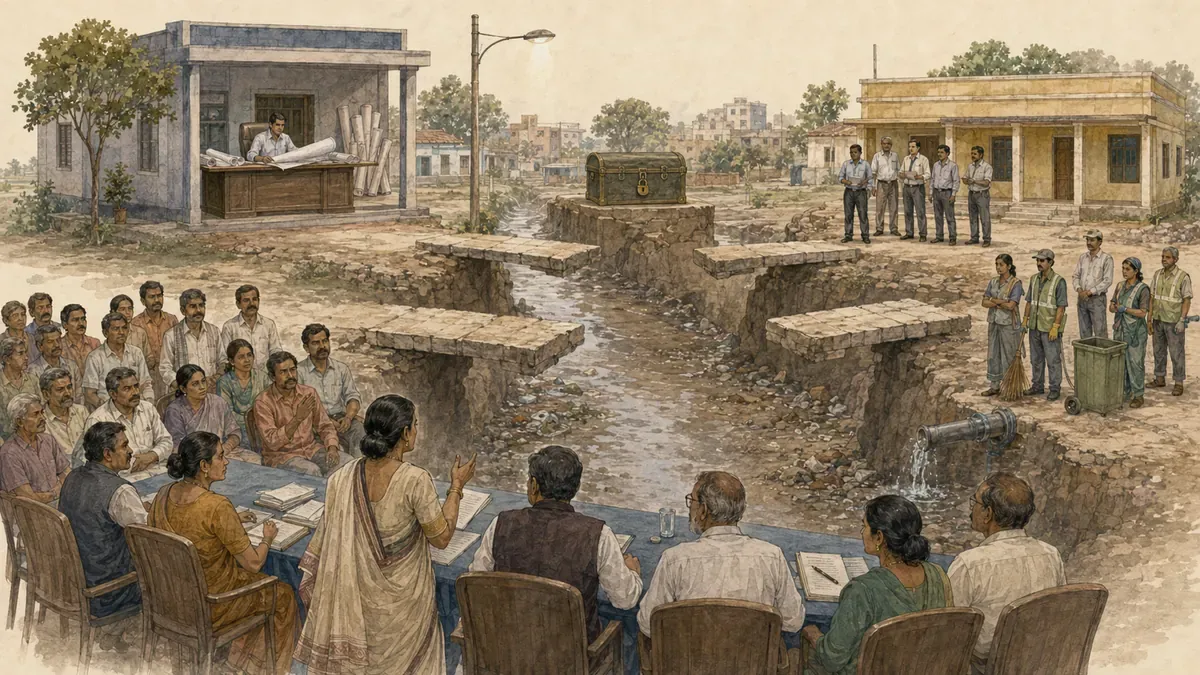
India’s Constitution already treats municipalities and panchayats as institutions of self-government. The difficulty is not the absence of constitutional design. It is incomplete devolution of functions, funds and functionaries, weak own-source revenue, irregular State Finance Commissions and thin channels for continuous participation between elections. India also has mature digital public infrastructure, but its components identify people, move money, hold documents or run sectoral services. None gives a resident a voluntary, portable and verifiable record of positive civic work.
This article proposes a Digital Civic Identity: a wallet of separate Civic Participation Credentials for verified civic acts, with no score, ranking, penalty for staying out, and no link to essential services or rights.
Reading the full article matters because the attractive part, rewards, is also the dangerous part. The constitutional limits, federal division of powers, privacy controls, permissible benefits, appeal rights and anti-gaming design determine whether this becomes democratic infrastructure or an instrument of discrimination.
It also shows why technology must follow constitutional allocation of authority, rather than obscure it behind a polished national interface.
| By the end, the reader will understand | Why it matters |
|---|---|
| What Parts IX and IXA actually guarantee | Constitutional status is not the same as operational autonomy. |
| Why Indian local bodies remain dependent | The fiscal problem is measurable, not rhetorical. |
| What existing digital schemes solve | The proposal should reuse infrastructure, not duplicate it. |
| Which legal instrument is needed at each stage | Most pilots need state rules, not a constitutional amendment. |
| How the design differs from social credit | Rights cannot depend on participation or a state-authored reputation. |
Introduction: constitutional cities, constrained city governments
Indian cities struggle despite constitutional protection. By 2036, about 600 million people, roughly 40 per cent of India’s population, are expected to live in urban areas. The World Bank estimates that urban infrastructure will require $840 billion over fifteen years. Yet the Union and state governments finance more than three-quarters of city infrastructure, while urban local bodies contribute about 15 per cent from their own surpluses. Property tax between 2011 and 2018 was only 0.15 per cent of GDP, against 0.3–0.6 per cent in comparable low- and middle-income economies. World Bank, 2022
The latest official balance sheet is equally revealing. The Reserve Bank of India found that the revenue receipts of 232 municipal corporations were only 0.56 per cent of state GSDP in the 2023–24 budget estimates. The Sixteenth Finance Commission reported that, across 3,895 urban local bodies, ₹69,937 crore of property tax was demanded in 2022–23 but ₹36,662 crore was collected. It also found that own-source revenue supplies 61 per cent of revenue in the largest cities but only 32 per cent in urban bodies below five lakh population. RBI, Report on Municipal Finances 2024; Sixteenth Finance Commission, chapter 10
The familiar diagnosis is the shortage of the “three Fs”: functions, funds and functionaries. A fourth shortage receives less institutional attention. Citizens are usually treated as voters, taxpayers, applicants, complainants or beneficiaries, not as continuing contributors to local governance. India has platforms for consultation, payments and service delivery, but no common method by which a resident can prove that she spent three evenings mentoring municipal-school pupils, joined a ward consultation, donated blood or helped restore a lake.
That missing record of civic contribution should not become a score.
1. The promise Parliament placed in the Constitution
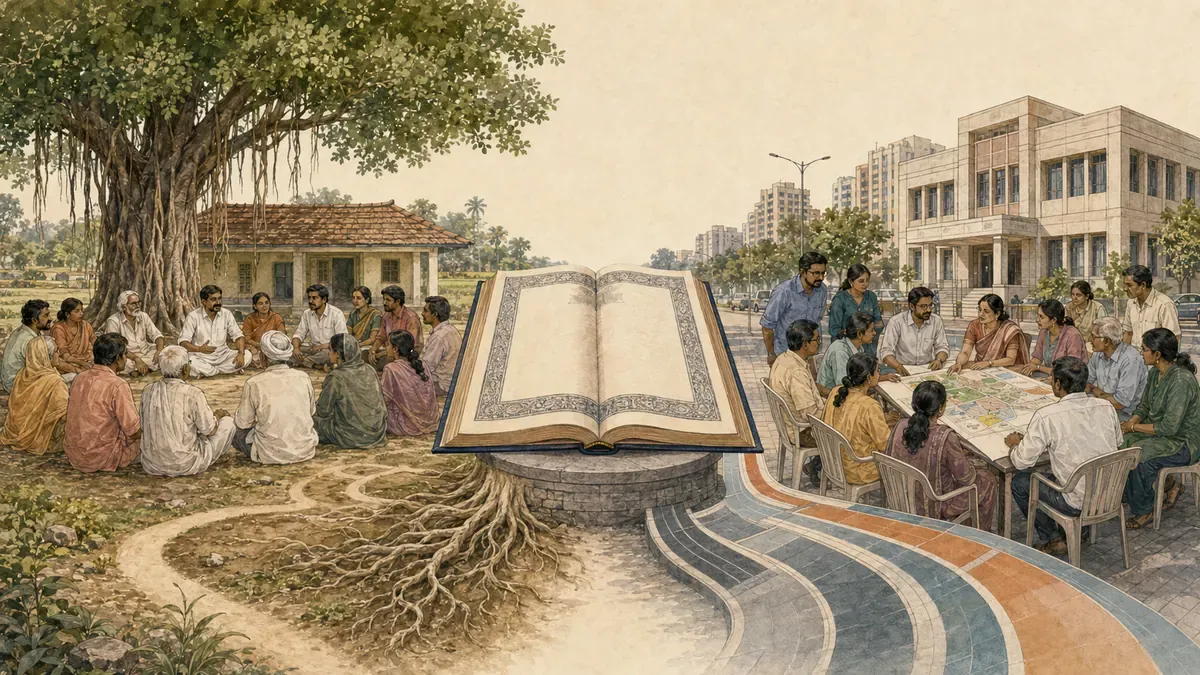
Local government is Entry 5 of the State List. The Constitution therefore establishes a common democratic floor while leaving states to enact municipal and panchayat laws. Article 40, a Directive Principle, says the State shall organise village panchayats and endow them with the powers needed to function as units of self-government. Articles 38 and 39 require a social order informed by justice, reduced inequalities and distribution of resources for the common good. These principles are not individually enforceable in court, but Article 37 makes them fundamental to governance. Constitution of India
The route to constitutionalisation was long. The Balwant Rai Mehta Committee in 1957 recommended democratic decentralisation through representative bodies, with development functions, revenue sources and staff at local levels. The Ashok Mehta Committee in 1978 argued for constitutional recognition. The 73rd and 74th Amendments, enacted in 1992 and brought into force in 1993, responded to irregular elections, prolonged supersession, weak representation, inadequate devolution and scarce finance. Ministry of Panchayati Raj on the committees; 73rd Amendment; 74th Amendment
| Constitutional block | What the text provides in plain English | Present limitation |
|---|---|---|
| Part IX, Articles 243–243O | Gram Sabhas; three panchayat tiers; direct elections; reservation; five-year terms; state election and finance commissions; taxation, audit and judicial rules | Articles 243A, 243G and 243H depend heavily on what state law chooses to confer. |
| Eleventh Schedule | 29 rural subjects, including agriculture, water, roads, education, health, welfare and community assets | A schedule identifies possible subjects; it does not itself transfer staff or budgets. |
| Part IXA, Articles 243P–243ZG | Three types of municipality; wards; reservation; five-year terms; ward committees; finance, audit, elections and integrated planning | Article 243W says a state legislature “may, by law, endow” municipalities, leaving devolution uneven. |
| Twelfth Schedule | 18 urban functions, from town planning and water to public health, environment, poverty alleviation and street lighting | Parastatal agencies and state departments often continue to control important functions. |
| Article 280(3)(bb) and (c) | The Union Finance Commission recommends measures to augment state funds for panchayats and municipalities, based on State Finance Commission recommendations | Delayed and non-comparable State Finance Commission reports weaken the intended chain. |
Part IX begins with definitions in Article 243. Article 243A allows a Gram Sabha, the body of registered village electors, to exercise powers that state law provides. Articles 243B and 243C create village, intermediate and district panchayats and regulate their composition. Article 243D reserves seats for Scheduled Castes, Scheduled Tribes and women; Article 243E fixes a five-year duration; Article 243F governs disqualification. Article 243G is the operational hinge: a state legislature may devolve planning and implementation for economic development and social justice, including the Eleventh Schedule’s 29 fields. Article 243H enables local taxes, assigned state revenues, grants and funds. Article 243I requires a State Finance Commission every five years; Articles 243J and 243K cover audit and an independent State Election Commission. Articles 243L–243O address Union Territories, excluded areas, transition and the route for election disputes. 73rd Amendment text
The repeated phrase “may, by law” is not accidental. The Constitution makes the institution and electoral cycle compulsory, then asks the state legislature to specify the operational content. A Gram Sabha therefore exists as a constitutional body, but its power to approve a plan, audit a beneficiary list or demand a response comes from the applicable state Act and rules. The Eleventh Schedule works in the same way. Its 29 subjects define the field of possible devolution; the agriculture officer, school budget or water engineer does not move to a panchayat merely because the subject appears in the Schedule. This distinction between a constitutional possibility and an administratively completed transfer is central to the “functions, funds, functionaries” problem.
Part IXA mirrors that architecture for cities. Article 243P defines the municipal area and a metropolitan area of ten lakh or more. Article 243Q requires a Nagar Panchayat, Municipal Council or Municipal Corporation according to the settlement’s character, subject to the industrial-township exception. Article 243R makes wards directly elected. Article 243S requires ward committees in municipalities of three lakh or more. Articles 243T–243V provide reservation, five-year terms and disqualification. Article 243W authorises devolution over the Twelfth Schedule; Article 243X covers taxes and funds; Article 243Y extends the State Finance Commission to municipalities; and Articles 243Z and 243ZA cover audit and elections. Articles 243ZB–243ZC address Union Territories and excluded areas. Articles 243ZD and 243ZE require District and Metropolitan Planning Committees to integrate rural and urban plans. Articles 243ZF–243ZG handled legal transition and channel election challenges through election petitions. 74th Amendment text
The planning provisions deserve attention beyond their abbreviations. A District Planning Committee must consolidate plans prepared by panchayats and municipalities, with at least four-fifths of its members elected from those bodies. A Metropolitan Planning Committee must prepare a plan for the whole metropolitan area, with at least two-thirds elected from municipalities and panchayats. Both are instructed to consider shared water, spatial planning, infrastructure and environmental conservation. They were designed for problems that ignore a ward boundary.
The credential proposed here must feed the legally competent District or Metropolitan Planning Committee and disclose what happened to the public input.
Article 280 completes the fiscal chain at Union level. The President constitutes a Finance Commission ordinarily every five years. Clauses 280(3)(bb) and (c) ask it to recommend measures to augment a state’s Consolidated Fund for panchayats and municipalities on the basis of State Finance Commission recommendations. Articles 243I and 243Y perform the prior state-level review: distribution of state taxes, assignment of taxes and fees, grants-in-aid and measures to improve local finance. The intended sequence is local needs, State Finance Commission assessment, state action and supplementary Union support. Delay at the second step forces the Union commission to work without the constitutionally anticipated evidence.
The Supreme Court has enforced the democratic floor. In Kishansing Tomar v Municipal Corporation of Ahmedabad (2006), it held that the five-year election timetable under Article 243U is mandatory. In State of Goa v Fouziya Imtiaz Shaikh (2021), it required State Election Commissioners to be independent of government office. These rulings protect representative legitimacy. They do not, by themselves, transfer engineers, tax authority or water boards to an elected council. Kishansing Tomar; Fouziya Imtiaz Shaikh
2. The gap between constitutional status and municipal capacity
The constitutional verbs matter. A municipality exists because Article 243Q says it “shall” be constituted. Its substantive powers, however, arise because Article 243W says a state legislature “may” endow them. Tax authority under Article 243X is similarly mediated by state law. This asymmetry explains why elections can be constitutionally regular while administrative autonomy remains partial.
State control is not, by itself, unconstitutional: local government remains a State List subject, and municipalities are statutory bodies operating within state legislation. The policy problem is opaque or incomplete assignment. A road may be maintained by the corporation, a development authority, a public-works department or a special-purpose vehicle. A resident sees one city; the file moves through several chains of command. Civic technology that merely collects reports can increase frustration if it does not identify the competent authority and a response deadline.
The Sixteenth Finance Commission describes full devolution as unfinished. It could not base its recommendations on State Finance Commission reports because their methods, periods and data quality were inconsistent. As of May 2025, states ranged from their second to seventh commission, while Meghalaya had not constituted one. The Commission also found different accounting systems: among reporting urban local bodies, 66 per cent used accrual accounting, 21 per cent cash accounting and 13 per cent mixed systems. Sixteenth Finance Commission, paras 10.2–10.4 and 10.69–10.81
| The “four Fs” | Constitutional intention | Administrative reality | Consequence |
|---|---|---|---|
| Functions | Eleventh and Twelfth Schedule subjects can be devolved | State departments and special-purpose agencies may retain planning, transport, water or housing | The elected body is blamed for a service it may not control. |
| Funds | Local taxes, assigned revenues and grants under Articles 243H/243X | Small cities depend more heavily on transfers; property registers and collection are weak | Budgets are uncertain and maintenance is postponed. |
| Functionaries | Powers should be usable by self-government institutions | Cadres, engineers and commissioners may answer primarily to state systems | Councils cannot reliably convert plans into execution. |
| Participation | Gram Sabhas and ward committees bring government closer | Attendance, consultations and volunteering are fragmented and rarely portable | Citizen effort disappears from the institutional record. |
Finance Commission transfers are growing, but grants cannot substitute for devolution. The Fifteenth Finance Commission recommended ₹4,36,361 crore for local bodies for 2021–26, including ₹1,21,055 crore for urban local bodies. The Sixteenth recommends ₹7,91,493 crore for 2026–31, of which ₹3,56,257 crore is urban, divided among basic, performance, special-infrastructure and urbanisation-premium components. That is a major fiscal opening. It is still channelled through states and eligibility conditions, and it cannot decide who runs a city’s water utility. Sixteenth Finance Commission, table 10.5
| Indicator | Current evidence | What it shows |
|---|---|---|
| Municipal-corporation revenue receipts, 2023–24 BE | 0.56% of state GSDP | The local public sector remains fiscally small. |
| Property-tax demand, 2022–23 | ₹69,937 crore | The assessed base is substantial. |
| Property tax collected | ₹36,662 crore | Billing, coverage and enforcement leave a large gap. |
| Urban infrastructure need to 2036 | $840 billion | Grants alone cannot close the investment requirement. |
| Infrastructure funded by Union and states | More than 75% | Cities remain dependent on upper tiers. |
| Own-source share, ULBs below five lakh population | 32% of revenue | Dependence is sharpest in smaller cities. |
A civic credential cannot repair weak devolution. It can make one neglected input, verified public participation, legible to the institutions that must act.
The Second Administrative Reforms Commission’s 2007 report on local governance argued for subsidiarity, clearer activity mapping, stronger State Finance Commissions, capacity and accountability mechanisms. NITI Aayog’s work on urban planning and city government similarly treats professional capacity and institutional coordination as core constraints. Second ARC, Sixth Report; NITI Aayog, Managing Urbanisation; NITI Aayog, Reforms in Urban Planning Capacity
The same caution applies to performance grants. Conditions can improve accounts, tax systems and disclosure, as the Finance Commissions intended. They can also penalise a small municipality that lacks staff to satisfy a uniform growth condition. The Sixteenth Finance Commission records that state claims meeting the Fifteenth Commission’s property-tax-growth condition fell from 22 states in 2023–24 to 16 in 2024–25, with most failures among cities below one lakh population. A civic-participation grant should therefore test institutional readiness and inclusion, not reward the largest raw number of credentials.
3. India has digital rails, but not this layer
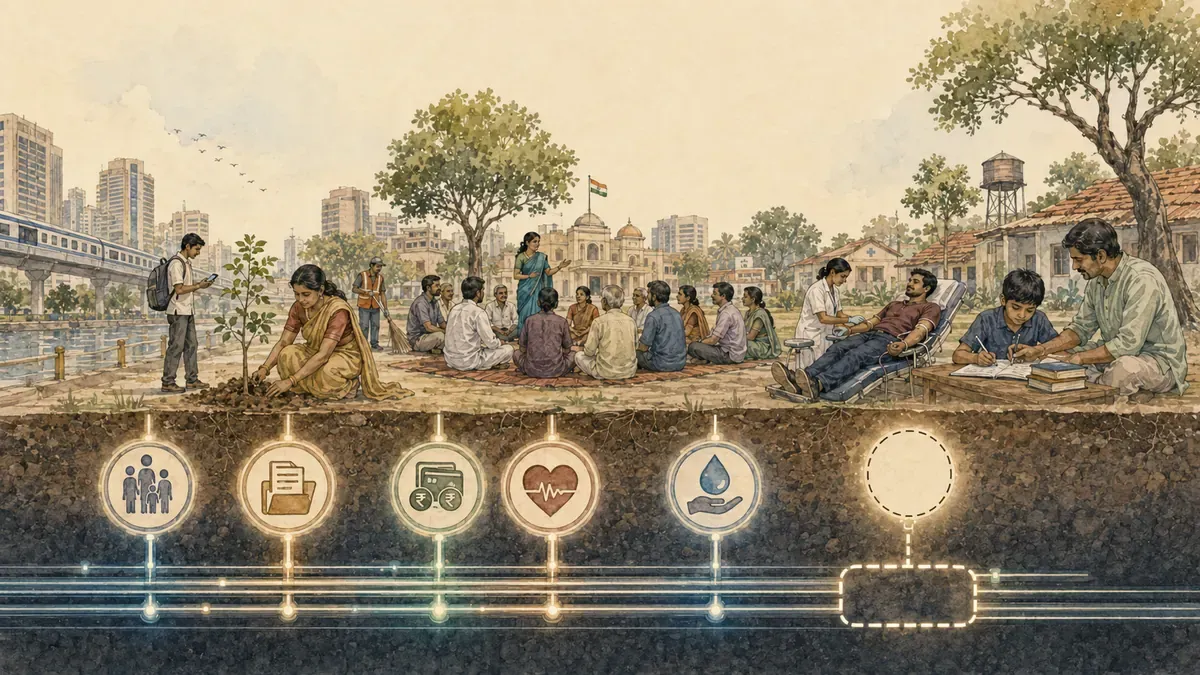
India does not need a new foundational identity or payment network. Aadhaar authenticates a resident but, as UIDAI states, does not confer citizenship or domicile and contains no intelligence about caste, religion, income, health or geography. DigiLocker stores and verifies authentic documents. UPI moves money. ABDM uses identifiers and consent to connect health records. These are distinct functions and should remain distinct. UIDAI; DigiLocker; ABDM
| Initiative | What it solves | What it does not solve |
|---|---|---|
| Digital India, Aadhaar, DigiLocker, UPI | Identity authentication, documents, payments and broad digital access | Verification of civic contribution |
| ABDM | Consent-based exchange of sectoral health information | Municipal participation |
| National Urban Digital Mission/UPYOG | Shared urban digital standards and reusable municipal services | A citizen-controlled, portable civic credential |
| MyGov | Discussions, polls, tasks and national or state engagement | Locally verified offline action and cross-city portability |
| Smart Cities Mission | Projects and technology through selected cities and SPVs | Universal ward-level participation infrastructure |
| AMRUT 2.0 | Urban water security, sewerage and institutional reforms | A durable contribution record |
| SBM-U 2.0 | Sanitation, waste systems, behaviour change and citizen campaigns | Interoperable credentials across civic domains |
| eGramSwaraj/AuditOnline | Panchayat planning, accounting, payments, assets and audit | A resident-owned participation wallet |
| PM SVANidhi | Working-capital credit and digital-payment incentives for street vendors | General civic participation |
The missing layer is not another portal. It is a common trust framework so local institutions can issue a narrowly described, citizen-controlled civic credential.
NUDM is the most relevant institutional host because it promotes standards and shared urban building blocks. eGramSwaraj provides a rural counterpart for planning, work accounting and fund flows. MyGov already demonstrates tasks, discussions, polls, pledges, points and badges. NUDM; MyGov; eGramSwaraj description, Ministry of Panchayati Raj
The urban missions solve tangible but different problems. Smart Cities financed projects in selected cities through special-purpose vehicles; AMRUT 2.0 concentrates on water security, sewerage and reforms; SBM-U 2.0 combines sanitation and waste infrastructure with behaviour-change campaigns. Their dashboards can count toilets, pipes, processing or projects. A civic credential asks a different question: can an individual carry a verified but privacy-preserving proof of contribution from one programme into a locally governed opportunity? The answer today is generally no. MoHUA, Smart Cities Mission; AMRUT 2.0 guidelines; SBM-U 2.0
PM SVANidhi illustrates the value and limit of a targeted digital incentive. It connects eligible street vendors to working-capital loans and promotes digital transactions. That is economic inclusion for a defined group, not a general theory of good citizenship. ABDM offers a more useful privacy lesson: sectoral records can be discovered and exchanged through consent without converting health data into a universal state profile. The civic layer should borrow the separation of roles, not any health attribute. PM SVANidhi; ABDM
4. The missing layer: a wallet, not a score

Build it as separate Civic Participation Credentials in a citizen-controlled wallet, not as a central profile or score.
Each credential should state only that an authorised issuer verified a defined event: “attended Ward Committee 12 consultation on 8 July”; “completed six hours of certified flood-response training”; “donated blood on a medically permitted schedule”; “municipal property account compliant for FY 2026–27”; or “mentored ten sessions in an approved programme.” It should not disclose medical details, political opinions, the content of a consultation submission or a resident’s complete activity history.
| Citizen journey | Data action | Constitutional safeguard |
|---|---|---|
| Opt in with Aadhaar or another accepted identity proof | Create a random civic-wallet identifier; do not expose Aadhaar to verifiers | Equality and meaningful alternatives |
| Join an approved activity | Issuer records the minimum event data | Purpose and data minimisation |
| Receive a signed credential | Credential goes to DigiLocker or another compatible wallet | Citizen custody and portability |
| Apply for a civic-linked opportunity | Share only the relevant proof, preferably a yes/no proof | Selective disclosure |
| Challenge an error | Human review, correction, revocation history and appeal | Fair procedure under Articles 14 and 21 |
| Leave the system | Delete wallet links and stop future processing, subject to short anti-fraud retention | Voluntariness and erasure rights |
There must be no composite score. Category-specific opportunities may ask for a relevant credential, but essential services and constitutional entitlements may never do so.
Credentials should not be added, weighted or ranked across domains. A person who donates blood is not “more civic” than a caregiver who cannot. Tax compliance cannot dominate because tenants and people without taxable property would be structurally excluded.
Rewards should remain modest and connected to participation: verified certificates; access to advanced volunteer training; transparent lotteries for civic-innovation microgrants; priority to present a proposal at a participatory-budget session; reimbursement of approved expenses; or recognition of a neighbourhood team. No credential should affect voting, welfare, ration, health care, school admission, housing, policing, credit, insurance, licences, ordinary municipal service, public employment or movement between states.
Even the phrase “rewarding taxpayers” requires precision. Paying a legally due tax is compliance, and property ownership is not equally distributed. A municipality may issue a compliance credential and invite compliant accounts to tax-literacy or neighbourhood-budget sessions, but it should not treat an owner as a superior citizen or give faster water, sanitation or grievance service. Tenants, students, migrants, caregivers and people unable to volunteer must have equal routes into every essential system and comparable routes into civic opportunities.
This is fundamentally different from China’s social-credit programmes, which have included blacklists, sanctions and cross-domain consequences. Here, non-participation produces no record and no adverse result; one activity cannot be converted into a general reputation; and the state cannot silently aggregate credentials. The closest international lessons are narrower and democratic.
| Jurisdiction | Useful practice | Realistic lesson for India | What not to import |
|---|---|---|---|
| Estonia | Secure e-ID, legally valid signatures and interoperable services | Reuse identity rails; log who accessed data | A mandatory civic profile |
| Taiwan | JOIN platform for proposals, petitions, consultation and oversight | Publish government responses and participation status | Online participation as a substitute for elected bodies |
| Singapore | SG Cares volunteer centres in all 24 towns coordinate opportunities | Fund local intermediaries that verify service | State-defined morality or essential-service preferences |
| Brazil | Participatory budgeting lets residents influence portions of municipal spending | Link verified deliberation to visible budget decisions | Treating attendance as proof of representativeness |
| South Korea | e-People routes petitions and policy suggestions to agencies | One routing and tracking layer with accountable replies | Conflating complaints with positive credentials |
| Japan | Local volunteering and “relationship population” initiatives build place-based ties | Allow non-residents to contribute to places they care about | Domicile barriers |
| Nordic countries | High participation rests on associations, local government and trust | Invest in institutions and offline access, not badges alone | Assuming digital access equals inclusion |
| Switzerland | Initiatives and referendums connect participation to formal decisions | Give participation a defined legal consequence where appropriate | Replacing representative government with permanent plebiscites |
Sources: e-Estonia, Taiwan JOIN, Singapore MCCY, OECD review of Brazil, Korea e-People, Swiss government.
5. The legal route: mostly state law, bounded by fundamental rights

The equality code supplies the outer boundary. Article 14 guarantees equality before law and equal protection. Any classification must have an intelligible basis connected to the policy objective, and state action cannot be arbitrary. Article 15 bars discrimination on religion, race, caste, sex or place of birth. Article 16 applies equality to public employment. Civic rewards therefore cannot become a disguised preference in recruitment or reproduce property, gender, disability or caste advantage. Constitution of India, Articles 14–16
Articles 19(1)(d) and 19(1)(e) protect a citizen’s right to move freely and reside anywhere in India, subject to reasonable restrictions under Article 19(5). A civic credential must consequently be portable and open to residents without birthplace or domicile preference. Article 21 protects life and personal liberty, including dignity, decisional autonomy and informational privacy. The nine-judge bench in K.S. Puttaswamy (2017) recognised privacy as a fundamental right; the later Aadhaar judgment demonstrates why identity infrastructure must be tied to lawful purpose, necessity and proportionality rather than made universally mandatory. Puttaswamy, 2017; Aadhaar judgment, 2018
The Digital Personal Data Protection Act 2023 and notified Rules 2025 now provide the operating law. Sections 4–6 require lawful processing, notice and valid consent; section 8 imposes obligations concerning accuracy, security and erasure; sections 11–13 give access, correction, erasure and grievance rights; and section 9 specially protects children. A civic system should not rely expansively on “legitimate uses” under section 7 when consent is feasible. It should publish a data-protection impact assessment, appoint an independent grievance officer and undergo annual security and discrimination audits. DPDP Act; DPDP Rules 2025 overview
Consent alone is insufficient where the government controls both the opportunity and the reward. A notice may be legally clear but practically coercive if declining means losing something important. The programme statute must therefore define a prohibited-use list, require a non-digital and non-participation route, and place the burden on the public authority to prove that a benefit is modest, related and non-essential. Procurement contracts should forbid vendors from reusing telemetry, training models on activity histories or combining wallet events with advertising, policing, credit or electoral databases.
The issuer is as important as the wallet. A local body should accredit institutions against published criteria, disclose conflicts, rotate sensitive verification roles and audit unusually high issuance. False credentials may be revoked after notice and hearing. The corrective action attaches to the credential and issuer; it must not create a secret “dishonest citizen” flag. A separate appellate officer or local-government ombudsman should be able to restore both the record and any missed civic opportunity.
| Proposal component | Current legal base | Present limitation | Required change | Privacy and implementation issue |
|---|---|---|---|---|
| Voluntary wallet | DPDP Act; DigiLocker framework | No civic credential trust framework | Union technical standard plus state opt-in rules | Alternative ID and offline wallet required |
| Municipal/panchayat issuers | State municipal and panchayat Acts; Articles 243G/243W | Participation functions and delegation vary | State rules defining issuers and purposes | Prevent political control of issuer accreditation |
| NGO, school and blood-bank issuers | Sector law and state accreditation | Evidence formats are inconsistent | Accreditation schedule and audit rules | Do not disclose health or beneficiary data |
| Ward/Gram Sabha credentials | Articles 243A and 243S | Meeting practice and records vary | Municipal/Panchayat procedure rules | Record attendance, not political opinion |
| Tax-compliance credential | Articles 243H/243X; state tax rules | Property ownership creates class bias | Rule allowing proof but prohibiting exclusive rewards | Keep account details outside civic wallet |
| Microgrants and recognition | Article 282 grants; state budgets; municipal funds | No common eligibility and audit method | Scheme guidelines and appropriation | Lottery or objective criteria; publish awards |
| Cross-state portability | Digital standards; Article 19 | Local definitions vary | Model state law and interoperable taxonomy | Do not create domicile preferences |
| Appeals and correction | DPDP rights; state grievance law | Data remedy may not reverse benefit decision | Statutory local appellate officer/ombudsman | Time-bound human review |
| Research dashboard | DPDP Act; municipal disclosure law | Small cells may reveal individuals | Aggregation and disclosure rules | No ward-level release below privacy threshold |
| Prohibition on adverse use | Fundamental rights and sector laws | Purpose creep can occur through data sharing | Express statutory firewall and penalties | Independent audit and private right to complain |
A pilot does not require a constitutional amendment. States authorise local issuers; the Union should stick to standards, safeguards and voluntary finance.
MoHUA and the Ministry of Panchayati Raj may publish open standards and fund consensual pilots; each participating state must authorise its local bodies through municipal or panchayat rules. Parliament may set data and interoperability safeguards within its competence, but it should not dictate municipal functions that belong to the State List. A later constitutional amendment is relevant only to the larger devolution problem, not to issuing voluntary credentials. Notably, the Sixteenth Finance Commission itself recommends reconsidering the phrase that requires the Union Finance Commission to act “on the basis of” State Finance Commission recommendations, because the reports remain unusable in practice. Sixteenth Finance Commission, para 10.81
Four legal vehicles should therefore be kept separate. Municipal and panchayat rules can authorise meetings, issuers, notices and local recognition. State legislation is appropriate for prohibited uses, appeals, local funds and cross-body recognition. Parliamentary legislation or rules may govern national data, digital-signature and interoperability safeguards within Union competence. A constitutional amendment should be reserved for structural fiscal or devolution questions. Using the heaviest instrument for every feature would delay experimentation; using executive guidelines for rights-sensitive features would leave citizens exposed.
6. Thirty constitutional and legal pressure points

Most of the proposal can move through state rules and municipal procedure. Legislation is reserved for rights firewalls, appeals and employment bans; a constitutional amendment is not the starting point.
The matrix below distinguishes changes that can be made by rules from those requiring legislation. “No change” means the provision supplies a guardrail, not that implementation is automatic.
| Current Constitutional Provision | Current law / scheme | Current practice | Current deficiency | Suggested reform | Legal change required | Expected outcome |
|---|---|---|---|---|---|---|
| Art. 14 | DPDP Act | Benefits use programme classifications | Credential rewards could be arbitrary | Equality impact test and non-exclusion clause | State rules | Defensible, proportionate rewards |
| Art. 15 | Anti-discrimination code | Protected identities are collected in many schemes | Proxy discrimination possible | Never encode religion/caste; audit outcomes | State rules; standards | Identity-neutral participation |
| Art. 16 | Public employment law | Merit and reservation govern recruitment | Civic points could distort recruitment | Absolute ban on employment preference | State legislation | Protect equal opportunity |
| Art. 19(1)(d) | Movement laws | Services often tied to local records | Portability gaps | Accept credentials from any compliant issuer | Model state law | Mobile citizens can participate |
| Art. 19(1)(e) | Residence rules | Some local benefits use domicile | Birthplace bias risk | Residence-neutral civic opportunities | State rules | No local nativism |
| Art. 21 | DPDP Act and Rules | Growing administrative datasets | Profiling and chilling effect | No score; selective disclosure; deletion | State legislation and technical standards | Privacy by design |
| Arts. 38–39 | Welfare and fiscal policy | Redistribution mainly through schemes | Participation channels stay peripheral | Fund inclusive civic microgrants | Budget/scheme rules | Social justice-linked participation |
| Art. 40 | State panchayat Acts | Gram Sabha powers vary | Participation may be ceremonial | Give defined agenda and response rights | State legislation | Stronger village deliberation |
| Art. 51A | Fundamental duties | Mostly declaratory | No safe enabling channel | Use as civic narrative, never coercive duty | No change | Contribution without compulsion |
| Art. 243A | Gram Sabha rules | Attendance and minutes vary | Contribution not portable | Signed attendance/action credentials | Panchayat rules | Verifiable rural participation |
| Arts. 243B–C | State panchayat Acts | Three-tier bodies exist | Roles overlap | Name competent issuer at each tier | State rules | Clear accountability |
| Art. 243D | Reservation law | Political representation protected | Digital participation may reproduce exclusion | Inclusion targets and offline facilitation | Scheme rules | Broader participation |
| Art. 243E | Election law | Five-year terms | Programme continuity may follow ruling party | Independent trust framework and archive | State legislation | Institutional continuity |
| Art. 243G | Eleventh Schedule | Devolution varies | Issuer authority may be unclear | Add civic participation to activity mapping | State legislation/rules | Lawful local issuance |
| Art. 243H | Local tax/fund law | Local revenue powers vary | Rewards may lack appropriation | Create capped Civic Participation Fund | State/municipal budget rules | Auditable funding |
| Art. 243I | State Finance Commissions | Irregular, non-comparable reports | Participation funding lacks formula | SFC assesses participation infrastructure | State SFC terms/rules | Formula-based support |
| Arts. 243J–K | Audit and SEC law | Audit/election safeguards separate | Programme could become electoral tool | Audit spending; freeze campaign-period promotions | State rules; election directions | Reduced partisan misuse |
| Eleventh Schedule | 29 rural subjects | Schemes operate in silos | No common verifier taxonomy | Map credentials to schedule functions | State rules | Comparable rural evidence |
| Art. 243P | Municipal definitions | Boundaries and categories vary | Peri-urban contributors fall between bodies | Cross-boundary issuer recognition | State rules | Inclusion during transition |
| Art. 243Q | Municipal Acts | Three municipal forms | Industrial townships may lack elected forum | Alternate public participation forum | State legislation/notification | Coverage outside municipalities |
| Art. 243R | Ward elections | Councillors represent wards | Participation data may bypass representatives | Councillor-visible aggregate dashboard | Municipal rules | Better representative oversight |
| Art. 243S | Ward committee rules | Mandatory above three lakh; design varies | Meetings may be weak or inaccessible | Notice, quorum, response and credential rules | State/municipal rules | Continuous ward democracy |
| Arts. 243T–V | Reservation, duration, disqualification | Elected-office rules | Credential could become candidacy condition | Ban qualification/disqualification use | State legislation | Protect electoral equality |
| Art. 243W | Twelfth Schedule | Functions incompletely devolved | Platform could mask weak devolution | Pair pilot with function mapping | State legislation | Participation tied to real authority |
| Art. 243X | Municipal tax/fund law | Property tax underused | Compliance badge favours owners | Multiple equal contribution routes | Municipal rules | Broader civic incentives |
| Art. 243Y | State Finance Commission | Recommendations often delayed | Grants lack stable civic-capacity component | Publish action-taken report and formula | State legislation | Predictable finance |
| Art. 243Z | Municipal accounts | Mixed accounting systems | Reward expenditure hard to compare | Common chart of accounts and open audit | State rules; MoHUA standard | Fiscal transparency |
| Art. 243ZA | State Election Commission | SEC controls local elections | Credential promotion could aid incumbents | SEC code on branding and data use | SEC direction/state rules | Electoral neutrality |
| Arts. 243ZD–ZE | District/metropolitan planning laws | Committees unevenly effective | Consultations disconnected from plans | Credentialed consultation plus response ledger | State planning rules | Traceable public input |
| Arts. 243ZF–ZG | Transition and election petitions | Election disputes follow special route | Civic disputes lack equivalent remedy | Separate administrative appeal; no election scoring | State legislation | Fast correction without election interference |
7. A ten-year route that starts small
| Horizon | Technology | Governance and law | Funding | Citizen participation |
|---|---|---|---|---|
| Year 1 | Open credential schema; wallet prototype; offline QR/paper option; no central activity database | 25 cities and 50 panchayats; state rules; DPIA; independent ethics board | ₹75–120 crore planning range | Co-design with disability, labour, tenant, women and civil-society groups |
| Year 3 | DigiLocker-compatible credentials; issuer registry; fraud analytics on issuers, not citizen ranking | Publish audits and equality outcomes; ombudsman; model state law | Performance grants for verified institutional readiness | Ward and Gram Sabha response ledgers |
| Year 5 | Federated national interoperability; selective disclosure; multilingual access | Parliamentary safeguards if cross-state data law needs strengthening; state adoption remains voluntary | ₹1,050–1,700 crore cumulative planning range | Participatory-budget and microgrant modules |
| Year 10 | Mature open ecosystem with certified public and nonprofit wallets | Independent regulator or board only if scale justifies it; statutory sunset reviews | Routine local budgets plus Finance Commission capacity grants | Participation measured by inclusion and outcomes, never raw credential totals |
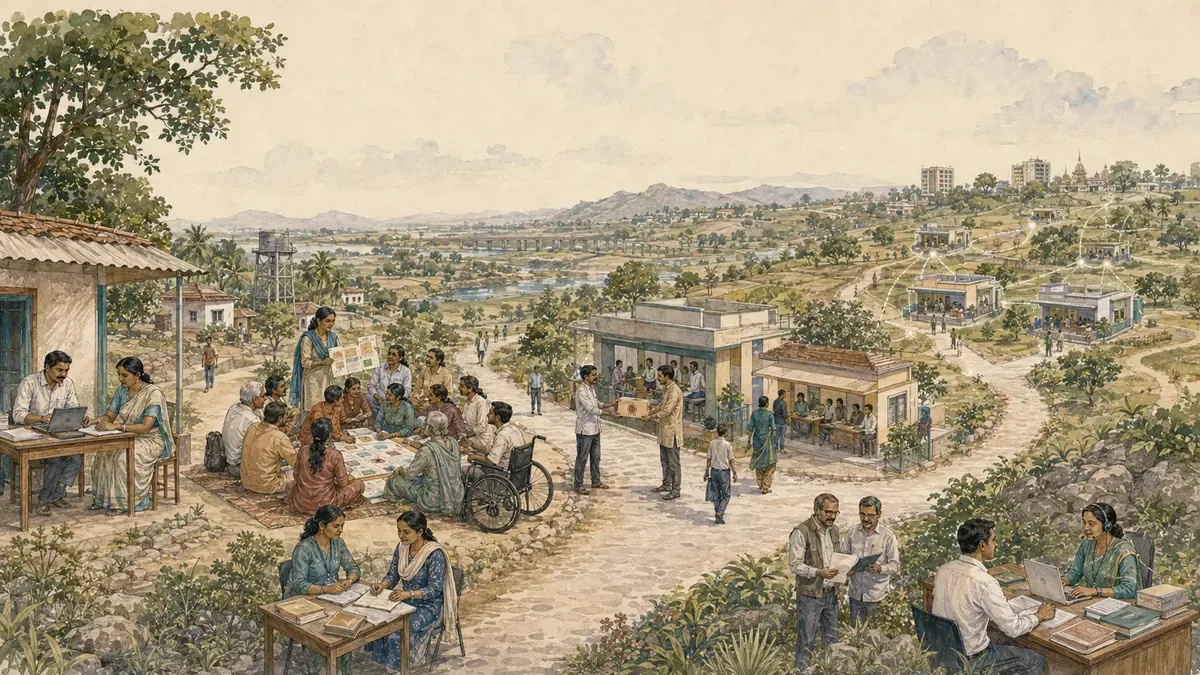
These are planning estimates, not government costings. The largest expenditure should be local capacity, accessibility, audits and grievance handling, not software. The core technology ought to be open source and reusable through NUDM and eGramSwaraj.
Readiness should precede scale. A pilot should fail if one department can set the rules, issue credentials, pick winners and decide appeals.
A pilot body should have an elected council, published accounts, a functioning grievance channel, a named data fiduciary, an accessible ward or Gram Sabha calendar and at least three independent issuer types. Separation of these roles is inexpensive institutional insurance.
| Illustrative five-year cost or benefit | Assumption | Order of magnitude |
|---|---|---|
| Pilot and evaluation | 75 local bodies, independent evaluation and accessibility | ₹75–120 crore |
| National open infrastructure | Standards, wallet interfaces, issuer registry, security | ₹300–500 crore |
| Onboarding, training and inclusion | Thousands of local bodies phased by readiness | ₹750–1,200 crore |
| Annual audit and grievance operation at scale | Security, equality, issuer and financial audits | ₹100–150 crore a year |
| Property-tax collection sensitivity | 1% of the ₹36,662 crore collected baseline | about ₹367 crore a year |
| Higher collection sensitivity | 5% of the same baseline; not a forecast | about ₹1,833 crore a year |
The fiscal sensitivities illustrate scale, not causation. A civic credential will not automatically increase tax receipts. It may support payment salience and trust only when paired with accurate property registers, fair valuation, simple payment and visible service improvement.
8. The risks are design requirements
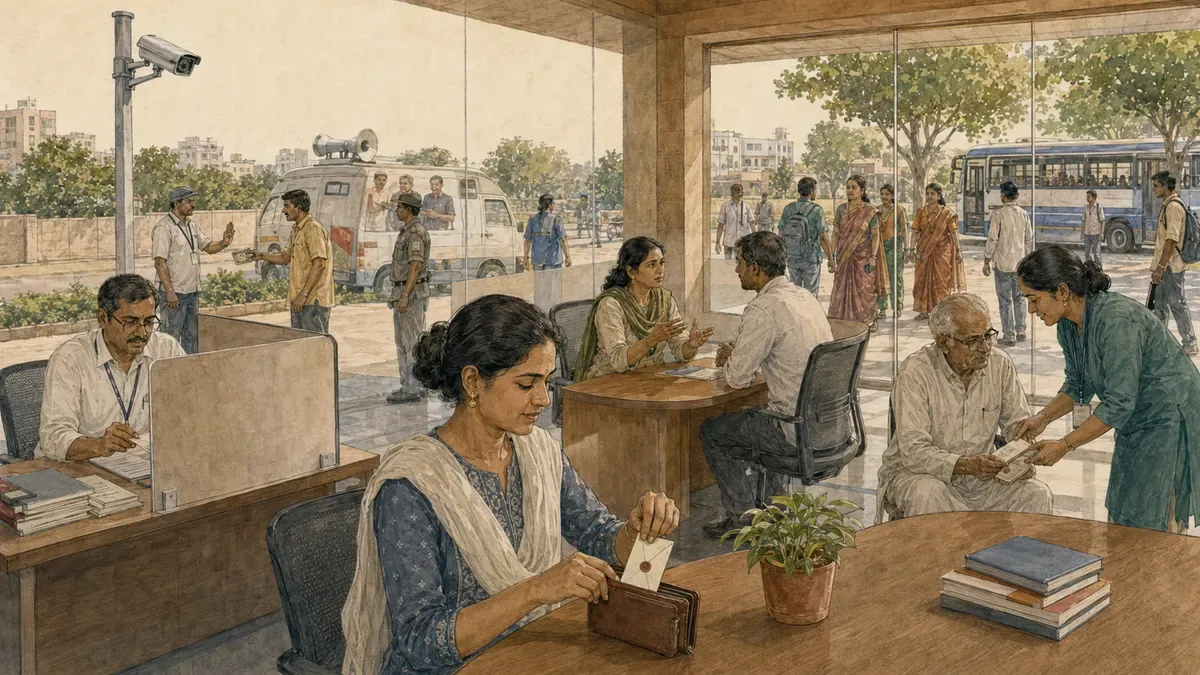
Treat every major risk as a design requirement: no score, no blacklist, offline access, issuer audits, and a hard ban on linking credentials to essential rights.
| Risk | How it materialises | Mandatory mitigation |
|---|---|---|
| Privacy | A complete activity history becomes a behavioural profile | Federated storage, selective disclosure, short retention, access logs, DPIA |
| Digital divide | Smartphone users collect more opportunities and proof | Assisted desks, paper credentials, IVR/SMS, travel reimbursement, offline activities |
| Political misuse | Ruling parties brand activities or target opponents | Independent issuer rules, campaign-period controls, aggregate public data only |
| Gaming | Fake attendance, collusive NGOs or duplicate events | Issuer audits, random verification, credential revocation and appeal; no citizen blacklist |
| Surveillance | Location or facial recognition becomes default proof | Prohibit continuous location, facial recognition and contact scraping |
| Urban bias | Cities receive better infrastructure than panchayats | Rural-first pilots through eGramSwaraj and equal funding formula |
| Corruption | Officials sell credentials or microgrant access | Public issuer registry, rotation, dual approval, whistle-blower route and audit |
| Constitutional litigation | Rewards burden rights or create arbitrary classes | Non-exclusion statute, modest related benefits, equality audit and severability clause |
Two additional failure modes deserve continuous measurement. First, opportunity inequality can arise before any credential is issued: affluent wards may have more accredited organisations, safer travel and flexible time. Funding must follow participation deficits, not existing activity volume. Second, performative participation can overwhelm substantive work. The public dashboard should therefore report completed projects, government response times and demographic access in privacy-safe aggregates, not celebrate the number of badges minted.
| Privacy safeguard | Default rule | Independent check |
|---|---|---|
| Data minimisation | Event, issuer, date, category and validity only | Annual schema audit |
| Purpose limitation | Verification for a named civic opportunity | Machine-readable purpose log |
| No aggregation | No total points or cross-domain rank | Algorithm and procurement audit |
| User control | Each disclosure requires an affirmative act | Wallet access history |
| Alternative access | Aadhaar and smartphone never sole routes | Mystery-shopper accessibility test |
| Correction | Human decision within a fixed period | Ombudsman appeal |
| Sunset | Credentials and programme powers expire unless reviewed | Legislative/public review every three years |
9. What the proposal can realistically improve
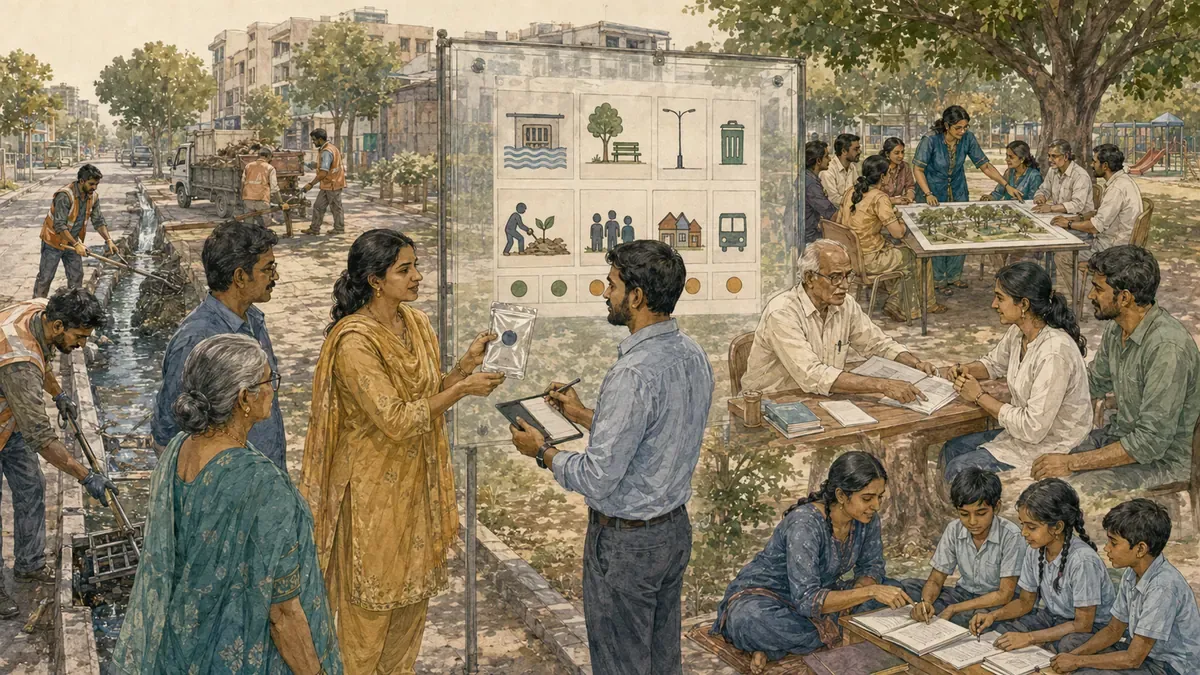
First, it can strengthen ward committees and Gram Sabhas without pretending that attendance equals consent. Article 243S creates a democratic site but does not create a portable participation record. Timely notice, a signed attendance credential and a public response ledger can show whether officials answered a proposal. The benefit is traceability, not a popularity score.
Second, it can connect fragmented schemes. SBM can verify neighbourhood sanitation work; schools can verify mentoring; accredited blood banks can issue a narrowly worded donation credential; disaster authorities can verify training or deployment. Common standards allow a resident to hold proofs together while each department retains its own lawful database.
Third, it can improve accountability for civic microgrants. Current grant systems mainly evaluate local bodies or projects. A credential system can document who was eligible, how a lottery or selection operated, and whether a promised activity occurred. Public aggregate reports can be audited without publishing individual histories.
Fourth, it can make non-financial contribution visible while acknowledging inequality in available time. Caregivers, shift workers and persons with disabilities must have accessible and remote routes. Category caps prevent tax compliance or high-volume volunteering from crowding out deliberation, mentoring or neighbourhood knowledge. Inclusion metrics should measure who is missing, not celebrate the largest number of badges.
Fifth, it can modestly support fiscal citizenship. A verified tax-compliance credential may link payment to civic information or recognition, but the more important reform remains the one prescribed by the Finance Commission: complete GIS-linked property registers, current valuation, better billing and fair enforcement. The credential is a communication layer around reform, not a substitute for it.
| Legal deficiency | Design response | Measurable benefit |
|---|---|---|
| Article 243W devolution is opaque | Publish a function-and-responsibility map beside each activity | Fewer misdirected grievances and clearer accountability |
| Article 243S provides a forum but not a response trail | Meeting credential plus public disposition of proposals | Share of proposals answered on time |
| Articles 243I/243Y suffer weak comparable data | Common participation-capacity indicators | SFC can assess access and operating cost |
| Article 243X revenue powers are underused | Payment proof plus service and tax information | Collection ratio, measured without ranking citizens |
| DPIs operate in sectoral silos | Interoperable, user-held credentials | Lower verification cost and fewer duplicate registrations |
Civic contribution must supplement equal citizenship and social justice. It must never replace remedial protection.
The proposal does not promise to dissolve identity politics. Constitutional democracy protects religious, linguistic and caste identities because historical exclusion is real; Articles 15, 16, 243D and 243T are safeguards, not distractions.
10. A democratic identity must know its limits
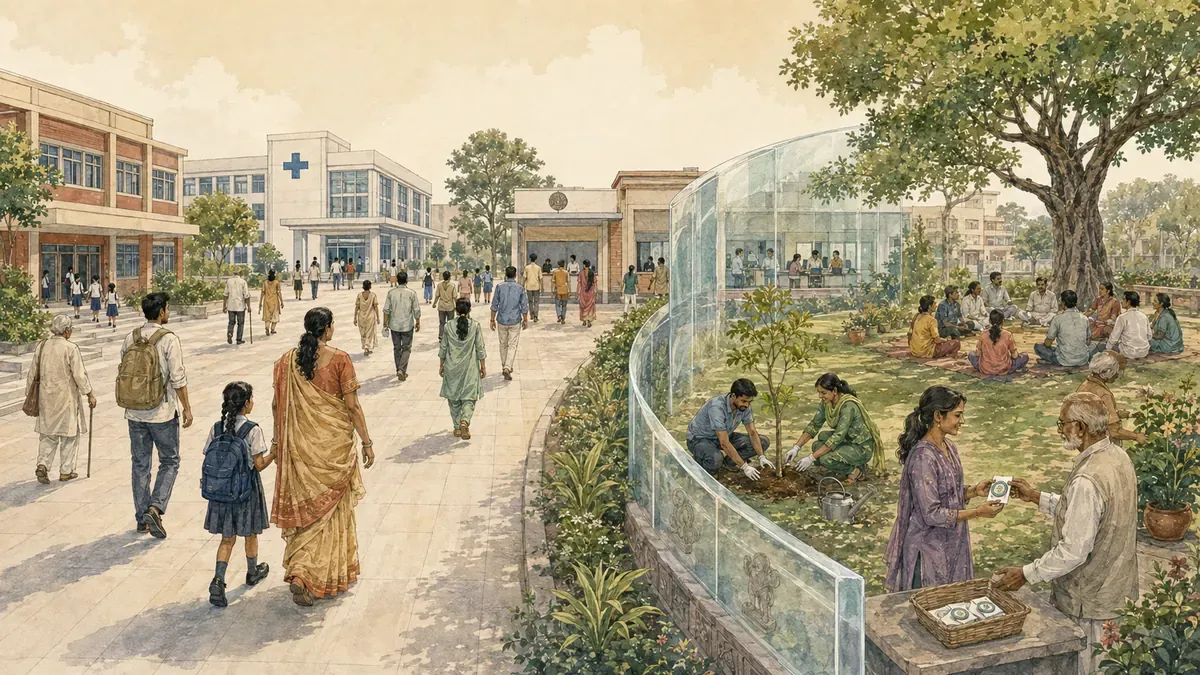
India’s constitutional local-government project is unfinished in a precise sense. Elections and representation have a firmer floor than the transfer of administrative power and revenue. Large national missions build assets and digital platforms, but a resident’s constructive work remains scattered across certificates, attendance sheets and institutional memory.
A Digital Civic Identity can fill that narrow gap if it remains narrow. It should record verified positive acts chosen by the citizen; give no penalty for silence; reveal no more than a particular transaction requires; and confer no advantage in essential rights, welfare or public employment. Municipalities and panchayats should issue the credentials under state law. The Union’s role should be standards, safeguards, interoperable public infrastructure and consensual finance.
The ultimate test is institutional, not technological. If a city can recognise a volunteer but cannot explain who controls its drains, the project has failed. If a Gram Sabha issues badges but receives no funds or staff, the project has failed. If a credential becomes a score, a blacklist or a condition of ordinary citizenship, it has failed constitutionally.
Equal citizenship remains unconditional; civic contribution becomes easier to verify; and local democracy gains a continuous channel between elections.
That would not replace the 73rd and 74th Amendments. It would help their participatory promise acquire an everyday administrative form.
Primary and institutional sources
- Constitution of India, Legislative Department
- Constitution (Seventy-third Amendment) Act, 1992
- Constitution (Seventy-fourth Amendment) Act, 1992
- Sixteenth Finance Commission, Volume I, 2026–31
- Fifteenth Finance Commission reports
- RBI, Report on Municipal Finances 2024
- World Bank, Financing India’s Urban Infrastructure Needs
- Second Administrative Reforms Commission, Sixth Report
- NITI Aayog, Managing Urbanisation
- MoHUA, National Urban Digital Mission
- MoHUA, Smart Cities Mission
- MoHUA, AMRUT 2.0
- Swachh Bharat Mission-Urban 2.0
- MyGov citizen-engagement platform
- Aadhaar Act, as amended
- Digital Personal Data Protection Act 2023
- DPDP Rules 2025 notification overview
- Supreme Court, K.S. Puttaswamy v Union of India, 2017
- Supreme Court, Aadhaar judgment, 2018
- Supreme Court, Kishansing Tomar, 2006
- Supreme Court, State of Goa v Fouziya Imtiaz Shaikh, 2021
Research current to 2 August 2026. Planning costs and revenue sensitivities are explicitly identified as illustrative estimates; they are not official projections.