The Spark That Became Us
How did chemistry become life? Explore abiogenesis, evolution, alien worlds, the Kardashev Scale, the Great Filter and the mystery of life in the cosmos.

A Lifeless World
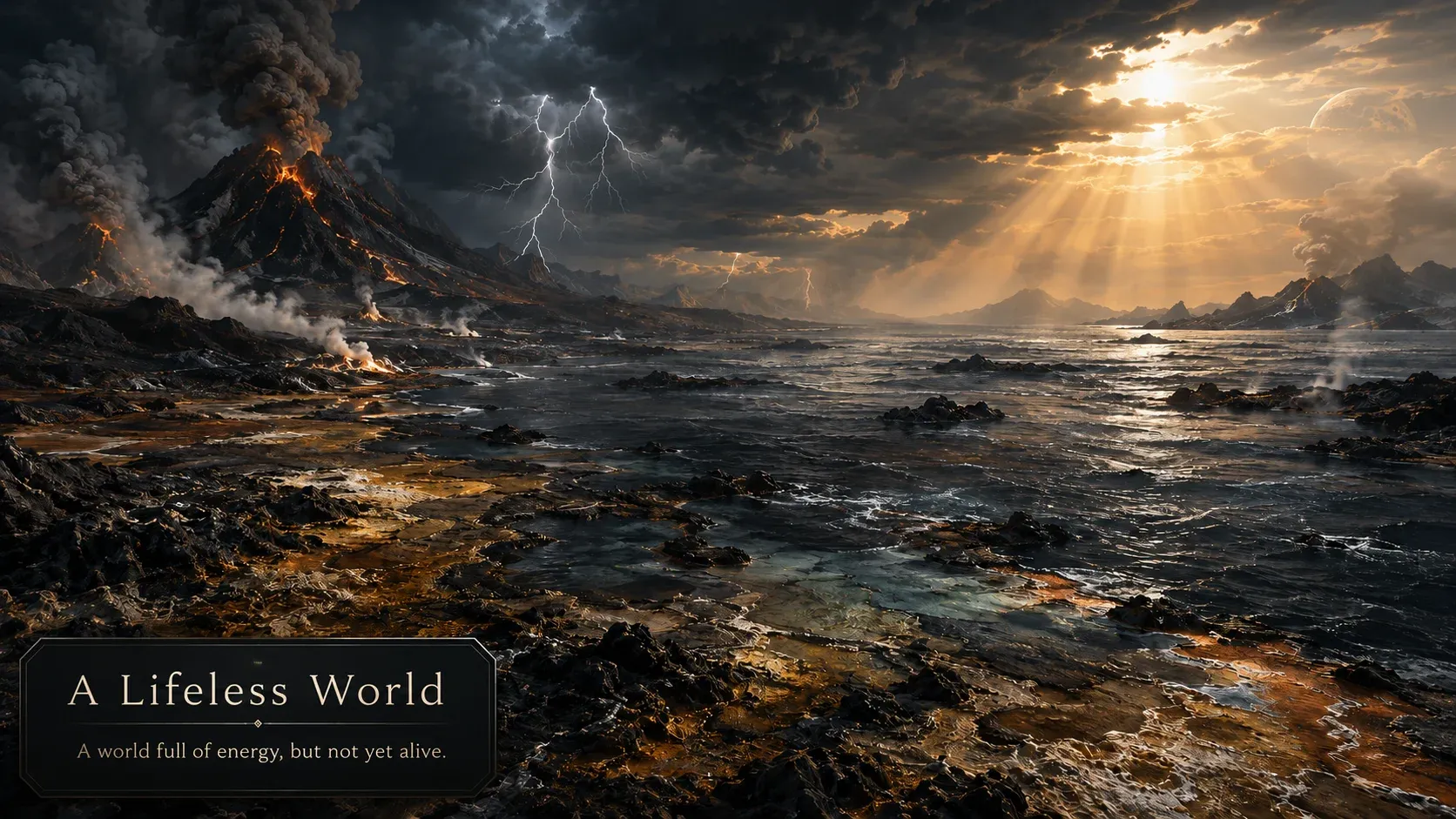
Imagine Earth exactly as it is today, but without life. No humans, animals, plants, bacteria or fungi. The oceans would still move. Storms would still form. Volcanoes would erupt. The Sun would continue pouring energy onto the surface.
The planet could contain carbon, hydrogen, oxygen, nitrogen, minerals and water. Chemistry would still happen everywhere. But nothing would be hungry. Nothing would hide from danger. Nothing would heal itself. Nothing would behave as though tomorrow mattered.
Then, somehow, that changed.
At some point in Earth’s early history, ordinary chemistry crossed a threshold. Scientists call the broad transition from nonliving chemistry toward living systems abiogenesis. We understand evolution fairly well once reproduction and inheritance already exist. What remains far more mysterious is how chemistry became capable of evolution in the first place.
That is the mystery at the centre of this story.
When Chemistry Began to Persist
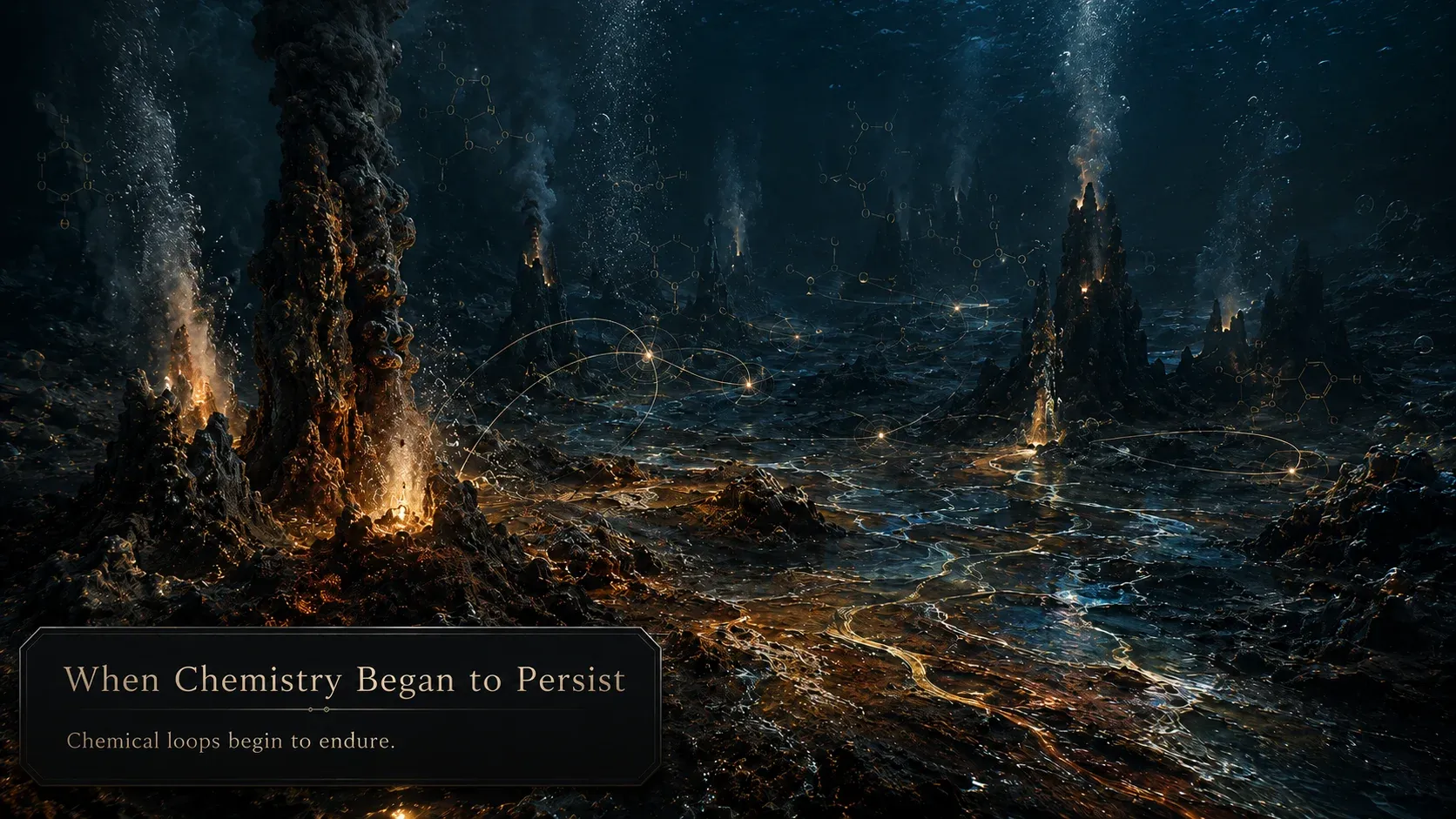
Life is not made from magical ingredients. The atoms inside us are ordinary atoms. What makes life unusual is the way matter is organized and the way energy continuously moves through that organization.
A living cell is constantly working. It takes in energy, maintains chemical differences, builds molecules, repairs damage and removes waste. When those processes permanently stop, the atoms remain, but the organized living system disappears.
This is why energy gradients may have been important at the beginning. Early Earth contained sunlight, geothermal heat, mineral surfaces and chemical differences created by water interacting with rock. Hydrothermal environments are interesting because they naturally produce such gradients.
Perhaps Earth’s first gift to life was not a miraculous molecule, but an imbalance that chemistry could exploit.
Some origin of life theories also explore autocatalytic networks, where chemical reactions help sustain other reactions within the same network. Such systems are not alive, but they introduce something important: persistence. Chemistry begins helping more chemistry continue.
That may have been one of the earliest steps toward life.
When Chemistry Acquired Memory
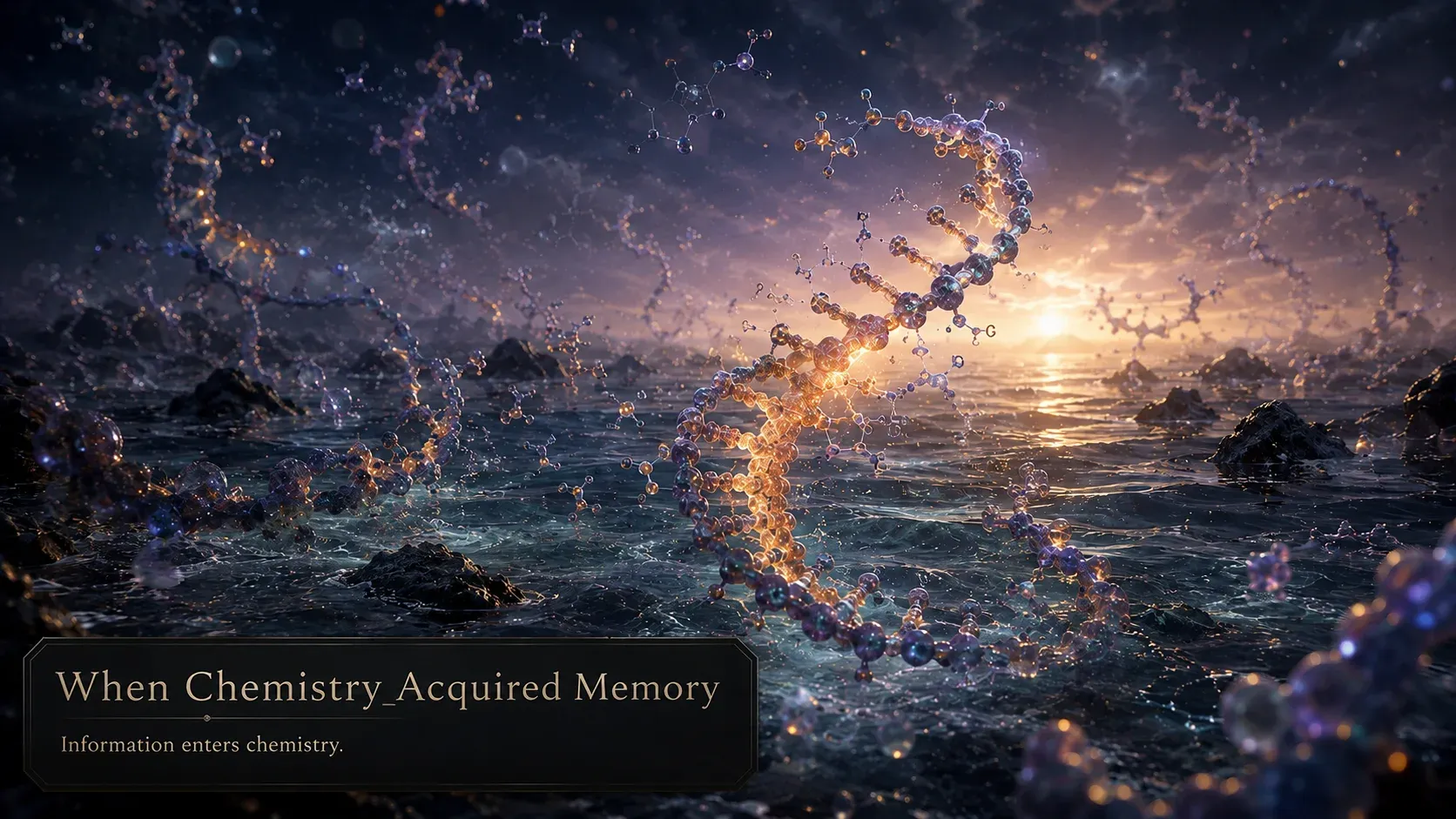
Persistence alone is not enough. Evolution needs information that can survive into the next generation.
This is where ideas such as the RNA World hypothesis become important. RNA can store information, and some RNA molecules can also perform catalytic functions. This makes RNA a possible bridge between simple chemistry and the sophisticated DNA and protein machinery found in modern cells.
Imagine a chemical system capable of producing imperfect copies. One version lasts slightly longer. Another reproduces faster. Another works better in a particular environment. Nothing is consciously trying to improve, but successful variations leave more descendants.
Now the past begins influencing the future.
Chemistry has acquired memory.
Once reproduction, variation and inheritance exist together, natural selection can begin. Over immense periods of time, simple differences accumulate into enormous complexity.
When Matter Began to Act as Though Survival Mattered
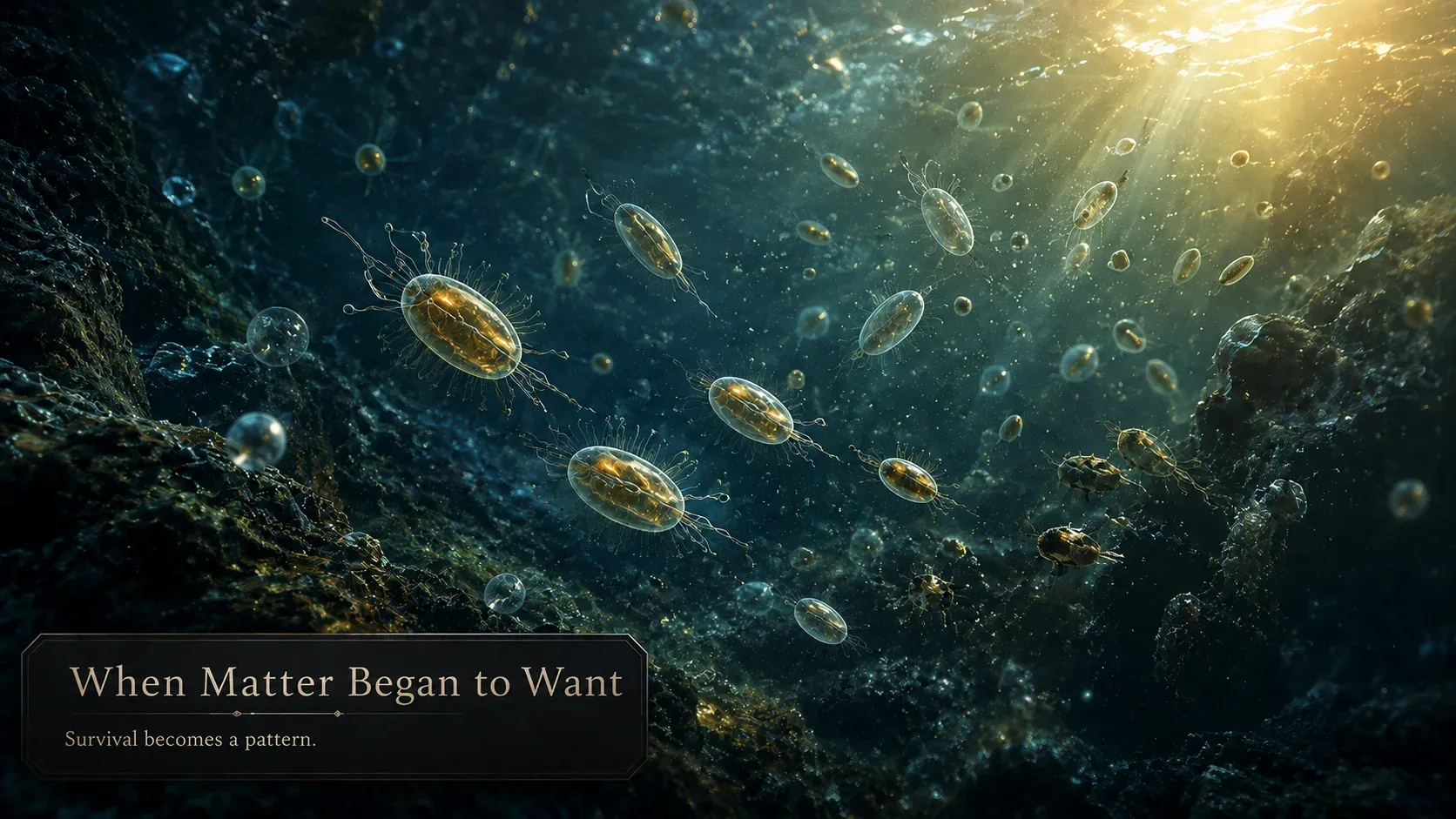
A bacterium moves toward nutrients. A plant grows toward light. An animal runs from danger. Humans build entire civilizations around survival, security and continuation.
None of this means early organisms consciously wanted to live. Natural selection requires no plan. Organisms that behave in ways that improve survival and reproduction simply leave more descendants.
But the result is remarkable.
Before life, nothing on Earth behaved as though its own future mattered. After life appeared, self preservation became one of the strongest patterns on the planet.
This is what I mean by when matter learned to want. It is a metaphor, but it captures a real transition. Matter became organized into systems whose behaviour helped preserve their own organization.
Evolution then began exploring every possibility the planet allowed.
Earth provided liquid water, carbon chemistry, sunlight, minerals and billions of years. Another planet might provide a different atmosphere, different temperatures or completely different sources of usable energy. Its life could therefore look nothing like ours.
Yet physics remains universal. Evolution on Earth repeatedly produced similar solutions in unrelated organisms. Eyes, flight and streamlined bodies evolved more than once. Alien life might therefore be completely unfamiliar in chemistry while still discovering surprisingly familiar solutions to similar problems.
The planet provides the materials. Physics sets the limits. Evolution explores what remains.
When Life Began Changing Its Planet
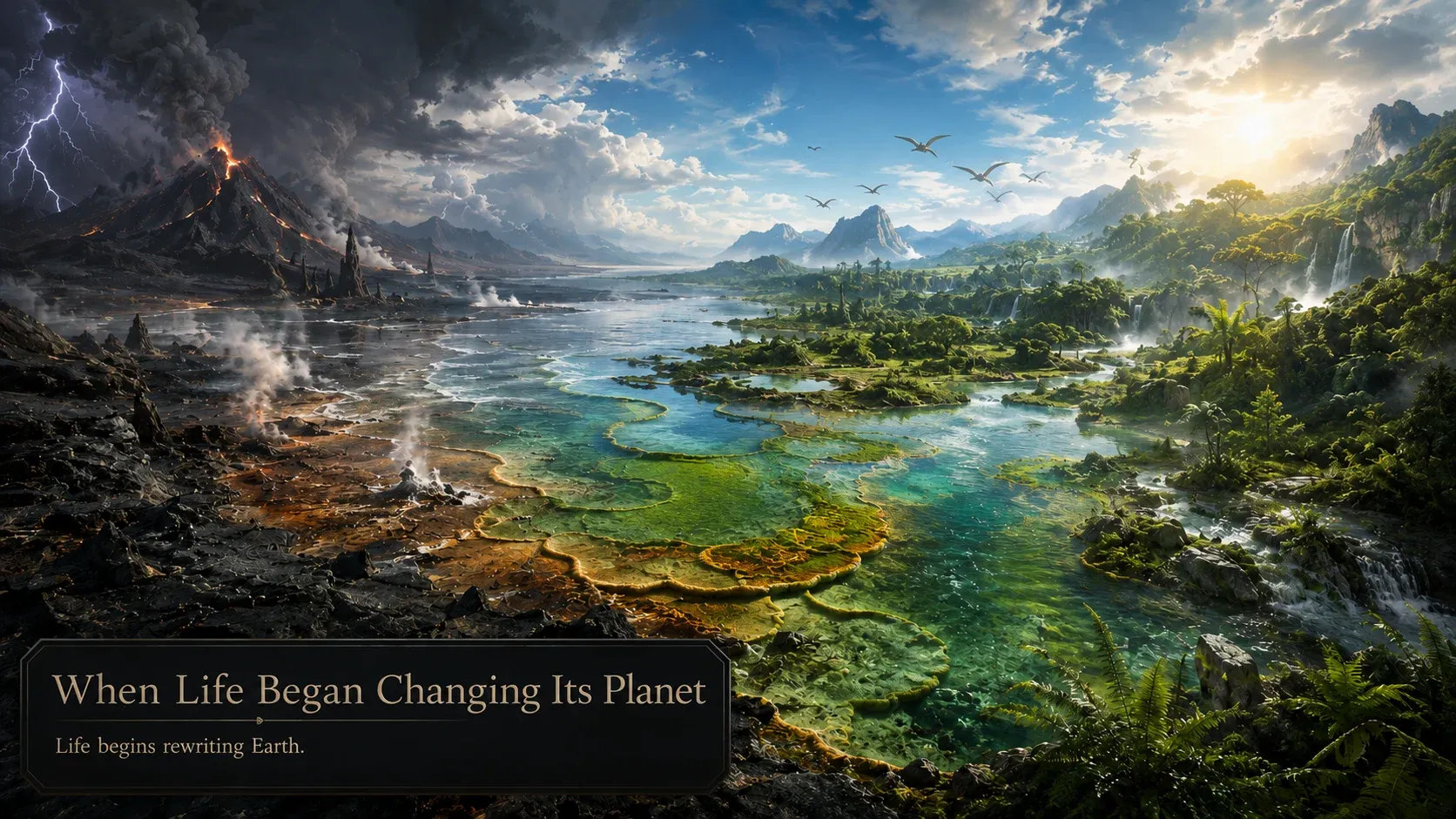
For most of its history, life adapted to Earth. Eventually, life became powerful enough to change Earth itself.
Photosynthetic organisms transformed the atmosphere. Plants changed landscapes and soils. Microorganisms altered planetary chemical cycles. Earth became a different planet because life existed here.
Then evolution produced brains.
Brains allowed organisms to learn during a lifetime instead of waiting for genetic evolution. Humans went further by learning how to store information outside the body. Language became writing. Writing became libraries. Knowledge accumulated. Science allowed discoveries to survive their creators.
Eventually technology became another rapidly evolving system.
Stone became tools. Metals became machines. Sand became computer processors. Sunlight became electricity. Rockets carried pieces of Earth into space.
Life was no longer simply adapting to its environment. Intelligent life had begun deliberately changing it.
When Life Learned to Control Energy
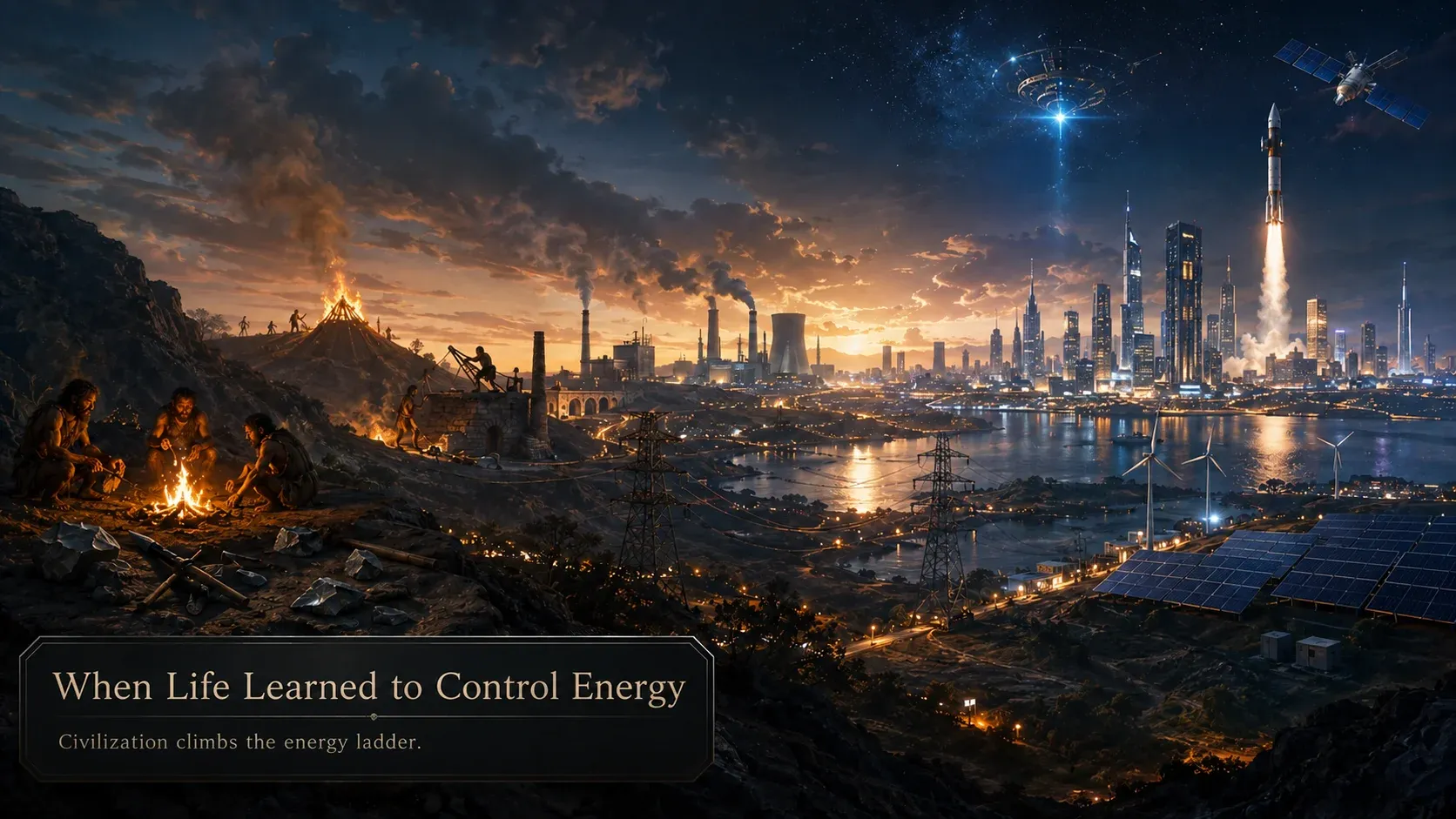
This is where the Kardashev Scale becomes interesting.
Nikolai Kardashev imagined advanced civilizations according to the scale of energy they could control. A Type I civilization operates at roughly planetary scale. Type II reaches the scale of its star. Type III reaches the scale of a galaxy.
Whether civilizations actually develop this way is unknown, but the idea continues the same story.
Primitive life begins by exploiting tiny local energy gradients. Plants capture sunlight. Humans discover fire, electricity, nuclear energy and solar power. Civilization gains control over larger and larger flows of energy.
A sufficiently advanced civilization might eventually manage energy across an entire planet.
A Type II civilization goes further. Concepts such as Dyson swarms imagine enormous systems collecting a significant portion of a star’s energy.
There is something almost poetic about that possibility.
The first life may have survived because energy from its star helped drive chemistry on its planet. Billions of years later, the descendants of that chemistry might deliberately build technology around the star itself.
Life begins completely dependent on its environment.
Eventually, life may learn to engineer that environment.
So Where Is Everybody?
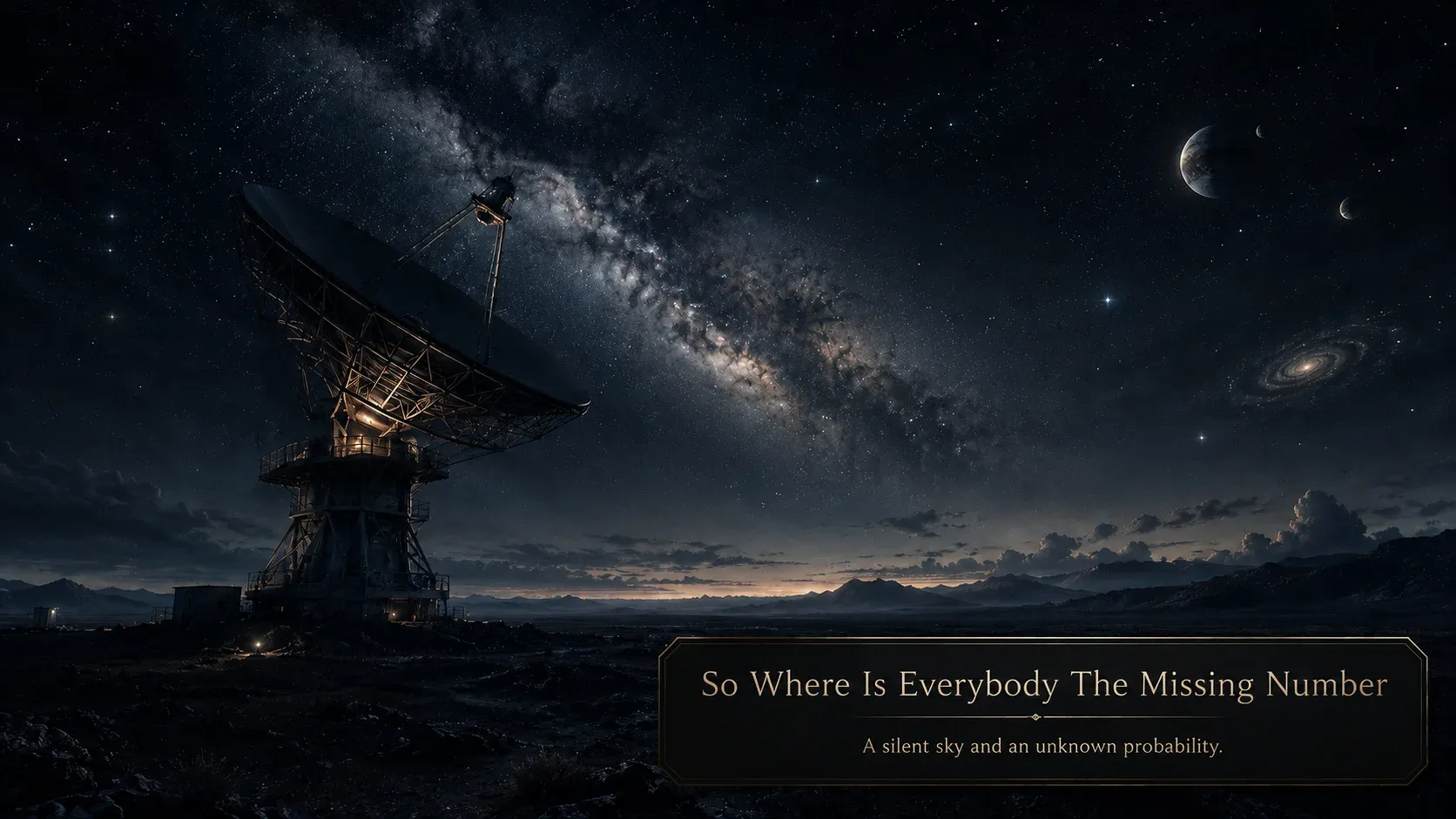
If planets are common, and life sometimes appears, and evolution occasionally produces intelligence, then some civilizations should be much older than ours.
Yet we have no confirmed evidence of them.
This tension is known as the Fermi Paradox.
Perhaps life itself is rare. Perhaps simple life is common but intelligence is rare. Perhaps technological civilizations destroy themselves. Perhaps interstellar expansion is much harder than we imagine. Or perhaps advanced civilizations become so different that we would not recognize their technology.
The Great Filter suggests that somewhere between lifeless chemistry and a lasting technological civilization there may be an extremely difficult step.
That step could already be behind us. Abiogenesis itself might be extraordinarily rare.
Or the filter could still be ahead.
That is why finding even simple independent life elsewhere would matter so much. If life appears easily, then the mystery moves further along the chain.
The Missing Number
The Drake Equation breaks the search for extraterrestrial civilizations into several probabilities. One of them asks how often life actually appears on suitable planets.
That may be the most important unknown in this entire story.
We know planets are common. We know organic molecules exist beyond Earth. We know water and energy gradients exist elsewhere.
What we do not know is whether a suitable planet almost naturally becomes alive given enough time, or whether Earth represents an astonishingly rare event.
We currently have only one confirmed example.
Us.
Did Life Begin Somewhere Else?
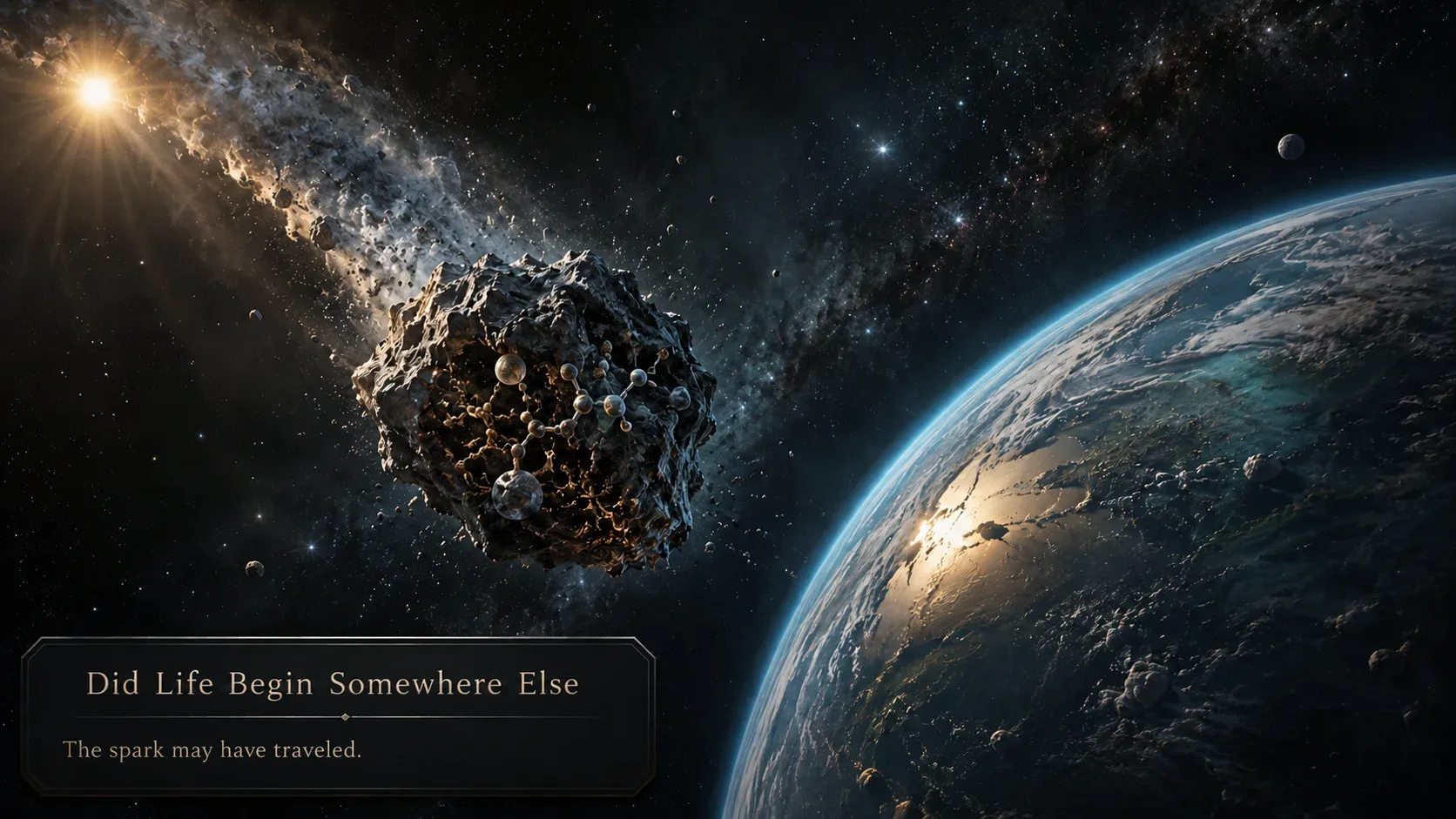
Another possibility is panspermia, the idea that life or its precursors could travel between worlds.
An even more speculative version is directed panspermia. An advanced civilization might intentionally seed lifeless but suitable planets with biological material.
Imagine intelligent beings evolving billions of years later on one of those planets. To them, the arrival of life might look like divine intervention.
But this only moves the mystery.
Who created the life that seeded their world?
Eventually, somewhere, nonliving chemistry still had to become biology.
Was There an Intervention?
If life requires an incredibly rare combination of conditions, it is natural to ask whether the process was somehow designed.
Science does not currently establish that conclusion.
Perhaps rare events simply happen when the universe contains enough planets and enough time. Perhaps deeper physical laws make life more likely than we understand. Perhaps some version of a multiverse exists, with observers naturally appearing only in universes compatible with life.
This connects with the anthropic principle. We should not be surprised to find ourselves in a universe capable of producing observers because otherwise nobody would be here to ask the question.
Design remains a philosophical possibility, but not a scientific conclusion.
Perhaps the most interesting position is simply to admit that we do not yet know.
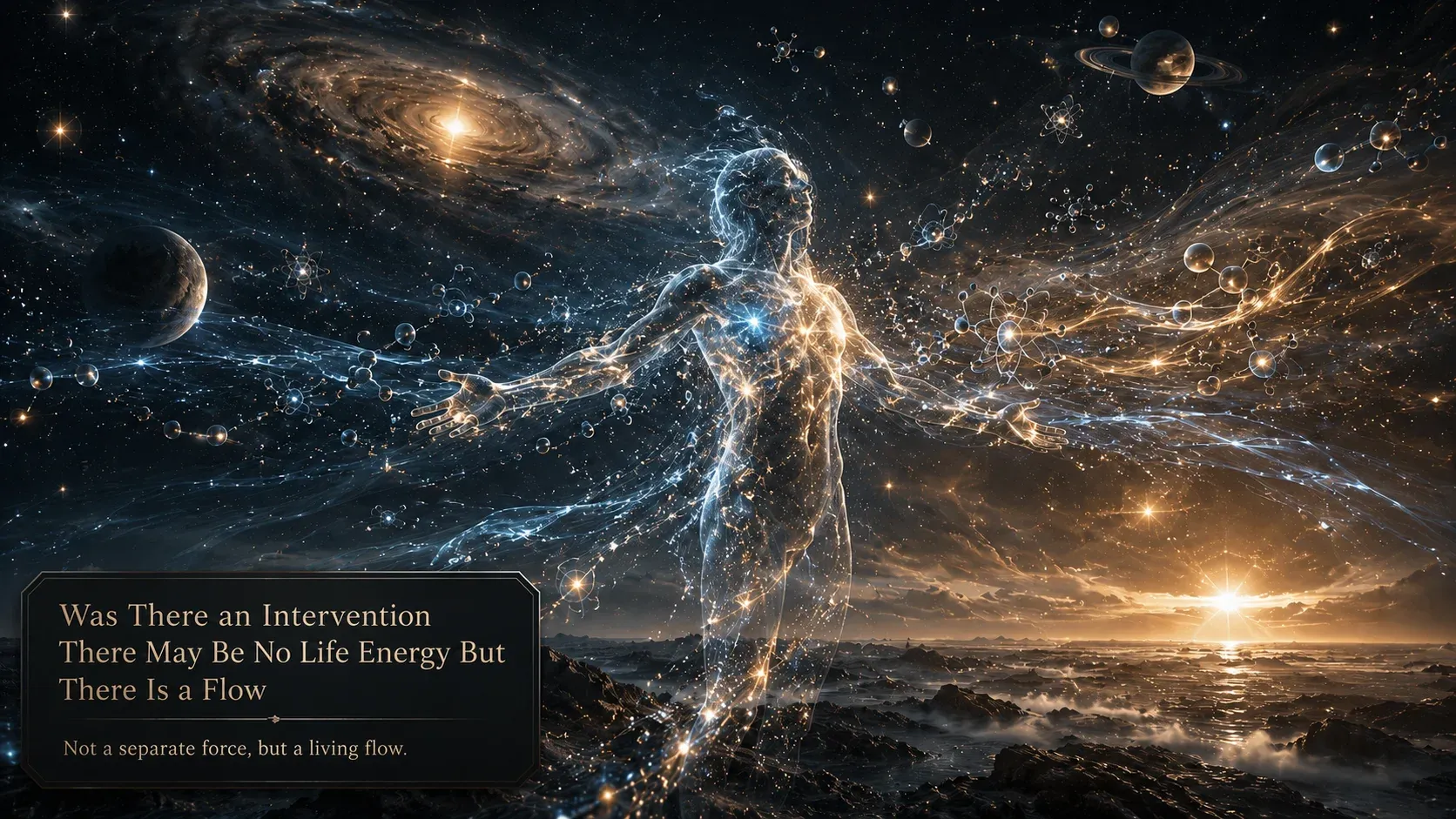
There May Be No Life Energy, But There Is a Flow
Science has not discovered a separate universal life energy that enters organisms and leaves them at death.
But something equally remarkable is happening.
Every organism temporarily organizes matter and energy that already existed in the universe. The carbon in your body existed before you. The oxygen you breathe existed before you. Matter continually enters and leaves your body throughout your life.
You are not a fixed collection of atoms.
You are a continuing organization.
For a while, matter forms a pattern capable of maintaining itself, remembering, thinking and experiencing the world. Eventually that particular organization ends, but the matter and energy continue participating in other processes.
Seen this way, life may be less like a substance and more like a temporary pattern through which matter, energy and information flow.
The Direction Reverses
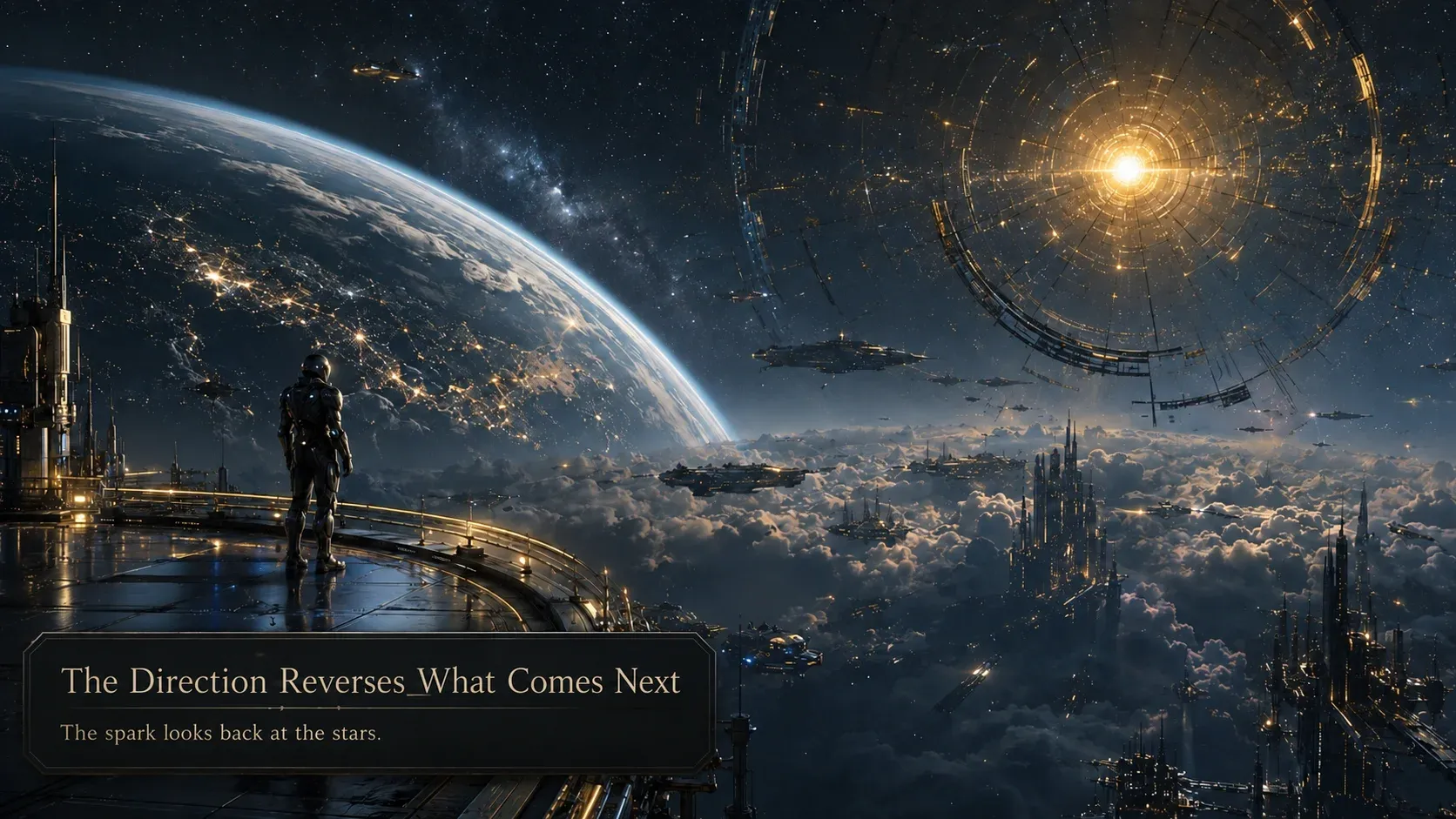
This is the part I find most fascinating.
At the beginning, the universe controls life. Gravity, chemistry, climate and available energy determine what organisms can become.
Then intelligence appears.
Life begins understanding those rules.
We learn chemistry, genetics, electricity and physics. We split atoms, edit DNA, build computers and send machines into space. The forces that once controlled us blindly become forces we learn to use deliberately.
The universe produced elements. Elements formed planets. Planetary chemistry produced life. Life produced intelligence. Intelligence began understanding the universe.
Now intelligence has started rearranging it.
For billions of years, the universe determined what life could become.
Life has now begun determining what small parts of the universe will become.
What Comes Next?
People sometimes say that conscious beings are the universe becoming aware of itself. That is philosophy, not established science, but the physical sequence beneath the metaphor is real.
Stars produced the elements that became planets. Planetary chemistry became cells. Cells became nervous systems. Nervous systems became humans. Humans built telescopes capable of studying the stars that created their elements.
The loop is extraordinary even without giving it a supernatural meaning.
Perhaps life is a cosmic accident.
Perhaps it appears almost automatically under the right conditions.
Perhaps intelligence is the rare step.
Perhaps civilizations capable of reaching Type II or Type III are almost impossible.
We do not know.
But maybe the deepest question is not simply whether aliens exist.
It is why matter has the ability to become something that preserves itself, stores information, evolves, becomes conscious, asks why it exists and eventually learns to manipulate the same forces that created it.
Somewhere on Earth, billions of years ago, chemistry began to persist. Persistence became inheritance. Inheritance became evolution. Evolution became intelligence. Intelligence became civilization. Civilization began controlling ever larger amounts of energy.
If that process continues long enough, perhaps the descendants of Earth’s earliest chemistry could someday capture much of the energy of the Sun.
Life begins because energy flows through matter.
Then life evolves until it can understand and control that flow.
Maybe life is not simply something that happens inside the universe.
Maybe life is one of the things the universe allows matter to become.
Conclusion: The Question Behind All the Others
Perhaps this entire story can be reduced to one transformation. A universe that began with matter and energy eventually produced arrangements of matter capable of protecting themselves, copying themselves, remembering their past and changing in response to their environment.
Those arrangements became life. Life became increasingly complex. Complexity produced intelligence. Intelligence produced technology. Technology has now given at least one species the ability to alter the planet that created it and to imagine extending that influence far beyond Earth.
What makes the story remarkable is that the same energy that once acted upon life is gradually becoming something life can understand and control. The earliest organisms were completely dependent on whatever energy their environment happened to provide. A sufficiently advanced civilization might one day deliberately manage the energy of an entire planet, and perhaps eventually a star.
This creates an extraordinary circle. The cosmos creates the conditions for life, life learns the rules of the cosmos, and intelligence begins using those rules to change its surroundings.
We still do not know whether this sequence is common or almost impossibly rare. We do not know whether life is waiting beneath the oceans of distant moons, whether technological civilizations have appeared elsewhere, whether the Great Filter lies behind us or ahead of us, or whether the first transition from chemistry to biology contains some principle we have not yet discovered.
And perhaps that uncertainty is more interesting than any easy answer.
The mystery is not merely that life exists. The deeper mystery is that ordinary matter can become organized into something capable of asking why it exists at all.
We started as chemistry responding to an energy gradient.
We became something that can study the stars.
What comes after us may be the next chapter of the same story.
References and Further Reading
NASA Science, Origin of Life and Early Earth Research. Research and educational material covering early Earth environments, hydrothermal systems, mineral surfaces, chemical gradients and possible pathways from prebiotic chemistry toward life.
NASA Astrobiology Program. Research on the origin, evolution and distribution of life, planetary habitability, biosignatures and the search for life beyond Earth.
NASA Jet Propulsion Laboratory, Origins and Habitability Laboratory. Research into prebiotic chemistry, mineral driven chemical networks, planetary geochemistry and the transition between abiotic and biological systems.
Michael P. Robertson and Gerald F. Joyce, “The Origins of the RNA World.” Cold Spring Harbor Perspectives in Biology. Review of RNA as an early information carrying and catalytic system, together with the unresolved question of what preceded the RNA World.
Research on Autocatalytic Networks and the Origin of Life. Scientific work examining how mutually supporting chemical reactions and self sustaining molecular networks may have contributed to the transition from chemistry toward biology.
Research on Hydrothermal Vent and Metabolism First Models. Work examining chemical gradients, mineral catalysts and geological energy as possible foundations for early metabolism.
Research on Convergent Evolution. Studies showing how unrelated evolutionary lineages can independently develop similar biological solutions when faced with comparable physical and environmental problems.
Adam Frank, David Grinspoon and Sara Walker, “Intelligence as a Planetary Scale Process.” International Journal of Astrobiology. A framework connecting biospheres, technological civilizations and the possibility of mature planetary intelligence.
Nikolai S. Kardashev, “Transmission of Information by Extraterrestrial Civilizations,” Soviet Astronomy, 1964. The original work behind the civilization scale later associated with Type I, Type II and Type III civilizations.
NASA Science, Technosignatures Research. Discussion of possible evidence of advanced extraterrestrial technology, including radio signals, atmospheric signatures, artificial illumination and large scale stellar energy collection.
SETI Institute, The Drake Equation. Explanation of Frank Drake’s framework for thinking about the number of detectable extraterrestrial civilizations and the unknown probabilities involved.
SETI Institute, The Fermi Paradox. Discussion of the apparent conflict between the possibility of widespread extraterrestrial civilizations and the lack of confirmed evidence for them.
Robin Hanson, “The Great Filter: Are We Almost Past It?” The influential argument that one or more steps between lifeless matter and long lived technological civilization may be extraordinarily improbable.
NASA Astrobiology, Panspermia Research and Discussion. Scientific discussion of whether microorganisms or biological precursors could be transported naturally between planetary environments.
Directed Panspermia Literature. Speculative scientific and philosophical work considering whether an advanced civilization could deliberately seed suitable planets with life.
Stanford Encyclopedia of Philosophy, Fine Tuning. Review of fine tuning arguments and possible interpretations involving physical necessity, chance, multiverse hypotheses and design.
Stanford Encyclopedia of Philosophy, Anthropic Reasoning and Cosmology. Discussion of observational selection and why observers necessarily find themselves in environments compatible with their existence.
James Lovelock and Lynn Margulis, Gaia related research and writing. Work exploring the interactions and feedback relationships between living organisms and Earth’s planetary environment.
Broader Astrobiology and Origin of Life Literature. Research concerning abiogenesis, non equilibrium chemistry, self organization, biological information, planetary habitability and the conditions required for life to emerge and persist.